Friday, April 18, 2014

Music Weird interviews Joe Dowell, part 2

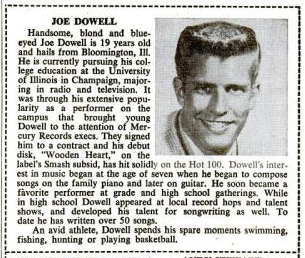
Billboard, July 3, 1961


Here is part 2 of my interview with Joe Dowell, which continues from here. In this segment, he talks about his first hit, "Wooden Heart," and his first album. 

The story of how he came to record "Wooden Heart" is much more involved than he describes here; you can read the full story in my liner notes to Dowell's CD on Bear Family Records. 


What was your first Smash session like? 

I went to the studio to my manager's office first, and while I was looking at my four songs, three of which I had written and one by Jodi Bancino called "Little Bo Peep," somebody came in the door with Elvis' album G.I. Blues. I thought that it could be a chance for a giant record because ["Wooden Heart"] was big overseas, big in England, around the world, but for some unknown reason, RCA Victor never released [it as] a single by Elvis in the United States.  

My managers got word of this, knowing of "Wooden Heart"'s already-great mileage for great success. They convinced me to do it that day, for we got the song on Elvis' G.I. Blues album just a few hours before the recording session. So I immediately began to learn "Wooden Heart" from Elvis Presley's movie track G.I. Blues, and they even hired a German teacher, Eddie Wilson, to tutor me the German. We were in the back seat of the taxi cab going to Bradley's Barn, working on the German in the taxi on the way to the microphone.  

Well, I got it down enough that I recorded it that day. Everybody liked it, but some unique things about the music: Whereas Elvis had an actual accordion, a real accordion, playing the certain German accordion-type licks, Ray Stevens was imitating the chintsy little accordion sound on an electric organ. So Ray Stevens, the famous guy with "Ahab the Arab" and "The Streak," before he was even known, he was playing the accordion—aping it—on an organ for "Wooden Heart." We had another, Jerry Kennedy, playing bass, whereas Elvis had an actual tuba going. Jerry Kennedy played the bass and imitated the tuba with his bass guitar. If I'm not mistaken, I think the Anita Kerr Singers and Jordanaires were in some of the background on that record.  

Nevertheless, we got a pretty unique sound. It was released in June of '61. Ninety days later, my single "Wooden Heart" found its way to #1 in the nation on the record charts.  So I was quite astounded, amazed. One person said that many people have to pay their dues, record five or ten years before they get a #1 record. This was my very first 45 I had ever even put out.  

But there is a funny story that maybe I'm not so proud of this, that I did a little bragging, like Joe Namath and the New York Jets. He said, "I know we're going to win the Superbowl."  Well, I said the same thing: I know my first record is going to go to #1. I just feel it. I know it will! Well, it did. But before I even recorded it, I had told a few people around Music City that my first record is going to go to #1, and I was ridiculed for that. They laughed at me, they tore me down behind my back, but then the story came from Red Sovine, and Red Sovine was a famous country singer, and I learned this from his son Roger Sovine—Red Sovine's son Roger. So, Roger told me one day that his dad revealed something quite funny, that when I first came to Nashville I was a little braggadocio, telling everybody my first record was going to be #1, and that was when the controversy, all the bad press—people were talking about and ridiculing that I had said, "Oh, I just feel that my first record is going to go to #1," and then Red Sovine told Roger that when it went to #1, all the backstabbing stopped on Music Row. They didn't say anything anymore. 


You said you recorded a few cuts before "Wooden Heart"?

Nothing. No records whatsoever.


You mentioned "Little Bo Peep."

Oh, that was on the same session.  


You did a four-song session?

Four-song session.


Who played the saxophone break on "Little Bo Peep?"

I think it was Boots Randolph.


It's amazing. It's really ferocious. That the hardest rocking performance of your career.

Yeah.


But that's not what you wanted to do.

No, it isn't.


It's a great performance!

I think it was Boots. Nobody could play sax [like him] and still, he's playing around, and he's a great, great musician.


You probably thought that you had it made after you immediately reached #1 with "Wooden Heart."

I was too obsessed with—and I know many others have been—I thought that would be a way to find inner fulfillment. Why do we.... Why are we driven? Maybe it's more than the fun of a little singing. Maybe it's more than just picking a little guitar. Maybe it is like the movie Fame. Maybe these life incidents cause certain things to happen where we are driven to try to make up for a vacuum or some kind of an emptiness. And I know, without question, that the motivation driving me was the tragic childhood and a lot of other things that happened too.

I was taught by culture that I was nothing and I had to make up for this sense of void, and if I get stage lights and fame and money then I would be happy. Nevertheless, I found that fifteen—maybe mine was fourteen and a half—minutes of fame.... Maybe it wasn't totally fifteen, but the phone began to ring as a kind of stamp of approval, kind of a little confirmation of fame. The phone began to ring, and lo and behold, one day it was Jimmy Dean. And he had a lot of fame at that time from "Big Bad John."


And his TV show.

Right. And Jimmy Dean wanted me to travel Canada with him. Patsy Cline was there on the stage, and George Hamilton IV again, and Jimmy Dean, and a little guy named Joe Dowell. I was only 21. And I had the privilege of traveling Canada with these famous stars.

For example, at the Calgary Stampede [Corral] rodeo arena, there were over 50,000 to 75,000 people that saw me sing, and I walked out with a guitar, and "Wooden Heart" had gotten to #4 in Canada.

And then I got to sing with Bobby Vinton, Minnesota State Fair, Tony Orlando & Dawn—did a show with them in New York. And I'll never forget, Tony walked up with my album and he commented that he loved it and a lot of his friends did.

And I sang with Phyllis Diller and Dennis Day, the great singer from Jack Benny's comedy show. This was the Milwaukee Spectacle of Music in Milwaukee, Wisconsin. And, interestingly, "Wooden Heart" sold more records in this German city of Milwaukee than any other city in America because of the German in it. And as a result, I was honored to be on the stage with Phyllis Diller and Jack Benny. Bing Crosby's band, Bob Crosby & the Bobcats, were the backup artists, the backup singers and band, that time.  


Milwaukee Sentinel, July 16, 1961


There were other opportunities to sing with some stars: Bobby Rydell in the Steel Pier in Atlantic City. A lot of doors opened to sing with Sheb Wooley at another state fair somewhere.


Did you make television appearances?

I made a few. There was a lot of interviews. Of course, when "Wooden Heart" was making it, what was fascinating was to help the label—I should have brought this in earlier, but it's still time. Just about the beginning of the release of "Wooden Heart," this was around June, I was sent with a very, very large man named Danny in a low-slung Thunderbird. We went on a one-month barnstorming tour to promote "Wooden Heart," and we traveled by car for one solid month to every major city east of the Mississippi to promote this little 45, "Wooden Heart": Chicago, Cleveland, New York, Philadelphia, Pittsburgh, Atlantic City, St. Louis, and all the major record-breaking towns in between. And one of the fascinating things to realize is there were about five other cuts of "Wooden Heart" that were sent to the radio stations I had to compete with. Well, fascinating—when I went to a town, the disc jockeys hadn't yet decided which version of "Wooden Heart" play. But because I went in with Danny and offered myself to go to interviews, to record hops, TV shows, they began to play my version.  So they went on the Smash Joe Dowell version of "Wooden Heart" and none of the others.  

Back at Mercury headquarters in Chicago, they observed a rather phenomenal thing. Every time I would go to a town—let's say Cleveland—and the radio stations would start playing my version, record sales would skyrocket, and they could follow my trajectory of promotion by the sales. Like little forest fires would start there, and then another forest fire would burst out there, and they could follow my journey of record promotion by the tremendous increase of record sales in those towns. For one simple reason: the disc jockeys would begin playing our version of "Wooden Heart." So there was some interesting things like that that took place in the early years of promoting "Wooden Heart."


Did the album follow then?

Within a few weeks.  


They rushed you into the studio.

Yeah, and did Joe Dowell Sings the Number One Hits, something like that.  And I recorded ten of the best top hit records, like "Lonely Boy" and "Dream Lover."


"A Hundred Pounds of Clay."

Yeah.  


Who selected those songs?

The executives at Mercury, Shelby Singleton, and a few others.


Then you had to learn these songs.

Crash course. Just learn them in a day or two.  


Your phrasing is very similar to the hit versions.

I was somewhat familiar with them and then played them again when I was in Nashville, rehearsing for the recording sessions. But I have to say, it was assembly-line recording, because these were ten songs I had never really done before. You don't have much time to be married, to get really familiar with the music and the lyrics, but it was a fun session. And I get ridiculed quite a bit for my haircut and the sweater look on the front of that album.  
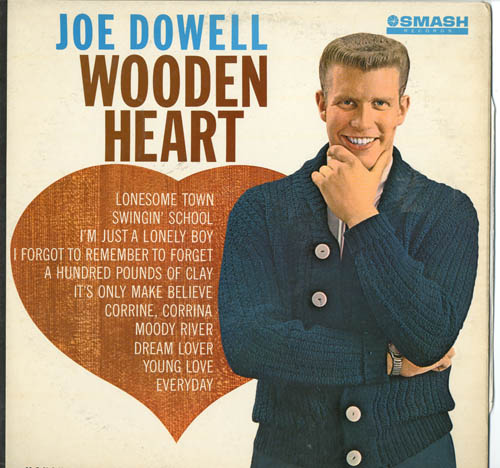


It's kind of a Bobby Rydell sweater.

Yeah. And that hair looks like a mini airport or a swimming pool, my daughters say.  


Did the label do that too, or was that your hairstyle?

Oh, I guess that was how I began to comb it for teenage record hops. Just kind of on my own. You get influenced by the looks of all the Bobbys of the world.

(Go to part 3.)

Monday, April 14, 2014

Music Weird interviews Joe Dowell, part 1


Joe Dowell topped the pop chart in 1961 with his recording of "Wooden Heart" from the Elvis Presley film G.I. Blues. Dowell was born in Bloomington, Indiana, where I live, and is one of two artists from Bloomington who topped the Billboard charts. (The other is Bobby Helms, who had #1 country hits with "Fraulein" and "My Special Angel" in 1957.)

Dowell's recordings, which also included the hits "Bridge of Love" and "Little Red Rented Rowboat," had never been anthologized, so I pestered Bear Family Records in Germany for two years to reissue them. I thought that Bear Family would be a good candidate to reissue these recordings, because "Wooden Heart" was based on a German folk song, and Bear Family was one of the only labels in the world that regularly licensed recordings from Universal Records, who owned Dowell's Smash masters. Universal was notoriously expensive and difficult to work with, so most reissue labels didn't bother with Universal-owned masters. 

Eventually, Bear Family said that they'd do it, and I started working on the liner notes. Dowell lived in Bloomington, Illinois, so he and I met at the Beef House in Covington, Indiana, on a Sunday afternoon for an interview.  

The whole experience was surreal. About 15 minutes before I reached the Beef House, my car's engine started roaring like it was about to explode, so during the entire interview, I was worrying about how I'd get home afterward, and how I could get my car fixed on a Sunday in Covington, Indiana. 

Dowell walked into the Beef House like a movie star with his hair, his big sunglasses, and his booming voice. He spoke in elaborate sentences and attracted a lot of attention from the people in the restaurant, who could tell that he was someone famous but didn't know who he was. At one point in the interview, I told Joe that he should record "Ebb Tide," and he burst into an a cappella rendition right there in the restaurant. 

Dowell had brought a friend with him, WJBC disc jockey Paul Dunn, who tried to stump me with oldies trivia throughout the interview. 

I recorded the interview with Dowell on a MiniDisc player that was loaned to me by Zach Downey, aka Zeke Durden, who later became internet famous as the "MulletMan" and the basis of the internet meme "Almost Politically Correct Redneck." 

Because of the length of the interview, I'm splitting it into parts. Here's the first part, in which Dowell talks about his early family life and how he was discovered. The interview was recorded on November 1, 2003. 


Talk about your family. 

My mother was a high school English teacher, but not only English. She taught advanced Latin, she was a librarian, and also was the play director. So she was all four things at Hayworth High School: play director, English teacher, Latin teacher, and she ran the library.

My dad, Harry F. Dowell, met my mother in Terre Haute, Indiana, and dad was a teacher of physics, French, taught the orchestra, led the orchestra, was also basketball and swimming coach, and he married one of his students: my mother. He quit teaching. [Teaching was] very bad financially, wasn't very much of a paycheck, and he got into Boy Scouting and moved to Bloomington, Indiana, where he was an assistant scout executive. And then he was offered a great position in Bloomington, Illinois. In 1941, the year after I was born, my parents moved to Bloomington in Illinois, where he was given a position of chief or head scout executive of the whole council area.  

We continued to stay there until he died in 1950 when he was only 47, and mother began then to take charge and run the household and teaching, roughly [from] 1950 until she retired in the early '70s. 

So both my mom and dad were very skilled leaders, and after mother retired, she exhibited a tremendous skill, great with leadership in being chairman of this, and head of the history club, head of the Association of Retired People. She was a program chairman for seven years of AARP and was quite well-known for getting outstanding programs for the retirement clubs and things of that sort. So my sister and I, Suzy, were very blessed with a noble and gracious mother and dad.


When did you start playing guitar? 


I was about 13 when I bought my first guitar, and that was already now three years after my father's death. And my sister Jo Ann, my oldest sister, died of sleeping sickness when she was seven, so I'd been severely thrown into upheaval by all this death in our family. And by the time I was 13, unable to really grasp the depth of all of this and the tragedy, I began to turn to music as a kind of a way to resolve, to handle, some of the anguish.  

So, at that age, 13, with a guitar in hand, I found it was a way to soften some of the anguish and some of the hurt I was going through, and became very familiar then with guitar playing at age 13, showing a heart that was pretty shattered. I wrote my first song, the lyrics of which are pretty telling. I felt as is I were being abandoned by the world. There was a lot of anguish that was tormenting me. And the first song lyric I ever wrote with a guitar was "tell me why you don't love me anymore." Obviously, expressing a sense of sorrow and loneliness, because it was not written to a girl or to a broken boy-girl relationship. It was a statement of psychology to the world in general: tell me why I'm unloved.  

And mother was suffering her own great tribulation of having lost her oldest daughter, beautiful young girl, through encephalitis, and then her husband just a few years later, and mother was dealing with her own emotions and could not be expected to be phenomenal child psychologist, God, teacher, homemaker, cook, and all that. So she really did not know what I was going through.  

By the time I turned 18 I was really writing songs, and that same year, 1958—three years before "Wooden Heart" was a smash—I wrote four songs called "The Quartet of Torment."  And these four songs were as dark, as black, as bleak as any songs could be. And I'm 18 now and began to have a hunger for approval, for attention, for fame. But those four songs—I won't give you the lyrics to now but I can give you the titles: One was on suicide, "The Song of the Morning Dove." The second was called "The Lonely Forest," which is a severe, dark song about excruciating loneliness. Third one, the song "What Ever Happened to Mr. Farrow," was a song on murder—a song that described how Mr. Farrow, with a killer bull, murdered his daughter and her boyfriend Damon because he did not want his daughter Sally to be married to Damon. And the fourth one was rather astounding; it's called "The Devil's in the Saw Blade," and it's an unconscious cry of what happened, why did the encephalitis have to burn up my darling sister's body? And "The Devil's in the Saw Blade" is a metaphor of the sleeping sickness that was ravaging, cutting through, slicing through my sister's brain. I was completely unaware of the subject of this song until I was 27. I'm writing a book on this, called The Unconscious Unleashed, and when I was 27, the hidden meaning of these songs came into my consciousness.  

But back to '58 and that "Quartet of Torment." That area was kind of a motivational factor to drive me to Nashville. Three years later, I'm a junior at college, and I think, "If I could just get a number one record I'd be happy. If I could become famous, this desolation of mind and soul, this shadow that had fallen over me, would vanish with the light, the applause, the excitement." Which really didn't work. But it drove me to go to Nashville at age 21.


Talk about how you were discovered.

In January of 1961, and it was during final exams and I had some time to borrow the Volkswagen of a friend's parents—his name was Bill Keyes—and we two went to Sparta, Illinois, picked up the Volkswagen of his parents, and drove to Music City, and that was January.  

But if you go back about a year, around 1960, a friend—John Coleman—who had a Dick Clark/Bandstand kind of show called At the Hop in central Illinois, Channel 3 in Champaign. 

John liked my singing. I met him through another TV show on the channel, and he asked me to travel around doing record hops. But he said I could not get on his TV show until I had a hit record. Well, fortunately, he introduced my to Don Merrill, who owned a theater—the Lorraine Theater, an old-fashioned kind of show theater in Hoopeston, Illinois. Don put on the Sweet Corn Festival every year. The annual Hoopeston Sweet Corn Festival. And he invited me to come sing when George Hamilton IV and Billy Grammer were on the stage that night.

And Don Merrill was right. He thought if these guys—George Hamilton IV and Billy Grammar—could hear me sing, they might be willing to give me some key people to meet in Music City, Nashville. So I entertained that evening, was well received, and George Hamilton and Billy Grammer gave me a bunch of key names, like Bill Denny, and other major publishing producers, record people in Nashville. Buddy Killen, who was a bass player and owned Tree Publishing, I sang for him.


What kind of music were you doing at this point?

Well, it was folk music. Not commercial, so to speak. The kind I was doing was minor, kind of an art song. So I went to Nashville with a bunch of names, thanks to George Hamilton IV and Billy Grammer, and it's about a year later, I'm ready to go: Guitar, briefcase full of songs, and I knock on the pavement of Music City for a week. I sing for all the people that these country stars told me to sing for. I was getting more and more disappointed because now it was Friday. It had been five days in a row, nobody interested in my stuff because it was too artsy. 

Finally, on Friday, I met the Wilburn Brothers, Teddy and Doyle Wilburn, and they liked my singing immediately, called Shelby Singleton, who had an office at Mercury across the street, and Shelby came over right away, and I sang for him "The One I Left for You."  Shelby loved it and said, "I will record him."  

Of course I was elated, and drove back to Champaign-Urbana, to the campus, very excited.  Some days later I got a phone call from one of the Wilburn Brothers, and they said, "Got great news—Mercury is establishing a brand new label called Smash, and they would like for you to be one of the singers to help this new label make a go." 

At first, I was very angry, because I wanted to be on Mercury. I thought of the names of so many big ones: Brook Benton, "How Much Is that Doggie in the Window?" 


Patti Page.

Patti Page was on the label. And I thought there would be so much more prestige and professional influence if I could be on a big-name label. But they convinced me that I could get lost in the pack, just be one more little pebble in this giant place of big stars. So, I had to say yes anyway, and was very fortunate that I did because I came out with "Wooden Heart" on Smash, which was really astounding because they used thousands of dollars to establish the label, promoting me and "Wooden Heart," and I was like on the crest of a wave. And the wave was really the publicity to establish "Wooden Heart"—not so much me. So I was caught up like a piece of driftwood in this tremendous flood of publicity to help establish the label.  

(Go to part 2.)

Saturday, April 5, 2014

The Sons of the Pioneers in Chicago: Music Weird interviews Hal Spencer


You might not think of Chicago as the heart of Western music, but the most famous Western vocal group of all time, the Sons of the Pioneers, lived there for just over a year in 1940-1941. 

While they were in Chicago, they performed on the WLS National Barn Dance and recorded over 200 radio transcriptions, called The Symphonies of the Sage, for NBC's Orthacoustic company. Many fans feel that these recordings are among the purest representations of the Sons' sound, because the group was able to choose the songs, write the arrangements, and play all of the instruments free from the influence of a record label.  

The Chicago reissue label Bloodshot Revival released a collection of these transcriptions in 2001, and while writing the liner notes for it, I interviewed Hal Spencer. Hal is the son of Tim Spencer from the original lineup of the Sons of the Pioneers and also the president and CEO of the publishing company Manna Music.

The original lineup of the Sons of the Pioneers was Roy Rogers, Bob Nolan, and Tim Spencer, but by the time the Sons moved to Chicago, Roy Rogers had left the group to pursue a solo career. In Chicago, the vocal group comprised Spencer, Nolan, Lloyd Perryman, and bass vocalist Pat Brady. Hugh and Karl Farr, the peerless cowboy jazz artists, added violin and guitar. 

I interviewed Hal Spencer twice on March 28-29, 2001. In the second interview, he provided details about a number of things that he didn't know in the first interview. 


Tim Spencer


You were pretty young when the Sons of the Pioneers were in Chicago. 

I was four. I was born in '36 and I think that was in '39.


Do you have many memories of that period?

Well, actually, I don't because [laughs]—of all things—I was hit by a car in Chicago right outside the hotel after the year that we spent there. It was just about a month or so before everbody left. In fact, Pat Brady was the one who ran out in the street and picked me up and pulled me over and took me to the hospital. So, as a result of that accident, I don't remember anything about the first four years of my life. Of course, a lot of people don't, but I don't. I remember the snow in the park across the street from the hotel where we lived, and that was about it.


Pat Brady


Where did you stay?

We stayed in a hotel. It was probably some type of tenement hotel, but I'm not absolutely sure. I can ask my mother.


Do you know how often the Sons were performing on WLS?

No, I don't.


During that year, about a half dozen of their films came out.  I assumed that they all were filmed the summer prior to the move to Chicago. Or were they shuttling back and forth from Hollywood?

My first impression would be that I think that they were shuttling, but I could find that out pretty easy from my mom.


Do you know of any interesting anecdotes from that period?

I know that, from what I recall from discussions afterwards, that it was a very busy and almost an unhappy time.

There was a lot of changes going on, pressures, and they were working extremely hard and were busy and doing a lot of stuff. At that particular time I think that there was some problems with the manager. From the general feeling over the years, the Chicago year was kind of a blur. They did the transcriptions and were happy to do it, but then afterwards, they kind of felt like maybe they had been taken advantage of when they signed off on artist royalties on the transcriptions, and felt like maybe they had made a mistake on the advice of my uncle Leo, that that would be a good deal. But in the long run it turned out to not be.  

But I think that was probably just one of the negatives. They felt that the radio work that they did in Chicago at that time was beneficial to their career—extremely beneficial—so they did feel like, from that standpoint, it was worth it. My dad and Bob didn't like all that work. They were more creative people, and that's why they retired as early as they did. They just didn't like the moving around and the going on concert tours and being gone all the time.

[Second interview with Hal Spencer, March 29, 2001]

I talked with my mother and then I talked with Karl Farr Jr., and Karl's a little bit older than me, so he knew a little bit. And, I don't know whether I got all the information, but....  I cannot find any photos. There's one other photo album that I found, but I haven't gone through it.  


Karl Farr


The hotel was located across the street from Lincoln Park. It was an apartment hotel with a bowling alley downstairs, and that's where everyone lived—all the Pioneers. Karl Farr Jr. did not live there. He stayed in California and lived with his grandparents. He only saw his dad, Karl. The first time, he didn't see him for nine months. His mother came back twice during that 14-month period. They were in Chicago from July 1940 through September 1941, which was 14 months.  

To the best of his knowledge, they didn't make any movies during that time—at least for nine months they didn't—because [Karl Farr] never came back to California. My mother says that she doesn't remember the Pioneers going off anywhere during that one-year period except for an occasional personal appearance, which would have been a couple of days if they went to the east, but most of the personal appearances were close enough to whereby they didn't have to go very far, and basically they did the Uncle Ezra show on WLS and stayed there.  


Karl Jr. said that he thought the name of the hotel was the North Park Hotel. My mother thought it was the Lincoln Park Hotel [a 500-room hotel at 1931 North Lincoln Park West], but it was an apartment hotel—it wasn't a regular hotel.  

Roy Rogers would come into town quite often, Karl [Jr.] says, because his dad would tell him, and his dad was a bowler. And Karl and Roy bowled a lot during the 14 months that they were in Chicago. 


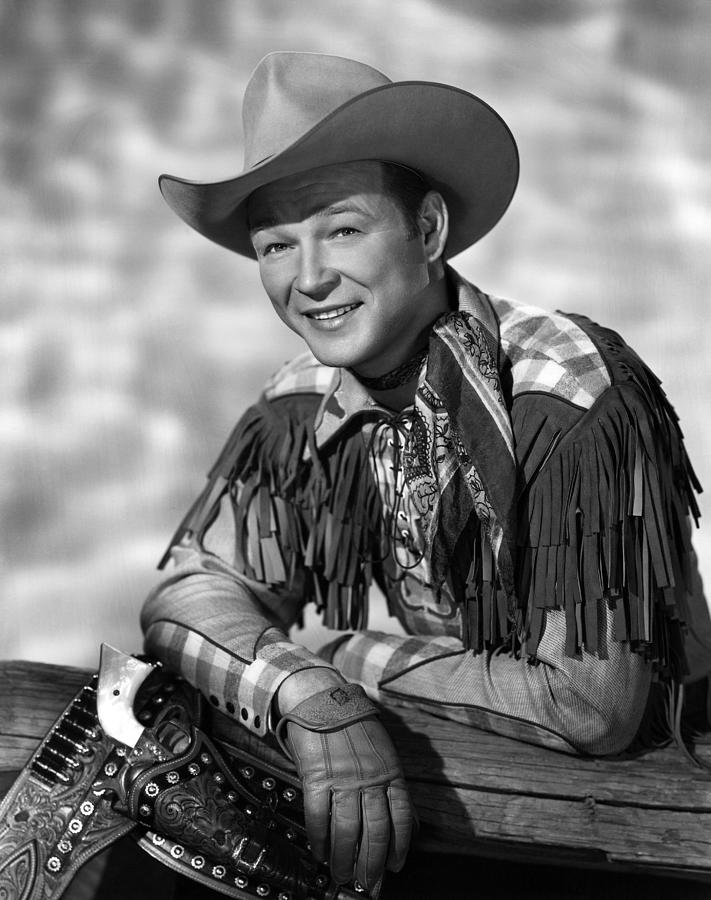
Roy Rogers


Now, Roy wasn't with the group, but he loved to bowl, and so did Karl, and for some reason he had a little thing going with Karl—a competition—so [Karl Jr.] can remember in the letters from his mom and dad, they would say, "Roy came in and Roy and Karl bowled for three days straight."

Also, my story about being hit by a car and being picked up out of the street by Pat Brady was another interesting thing that both my Mother and Karl remember being told.  


How often were the Sons on WLS?  

Karl Jr. and my mom did not know for sure whether it was a weekly show or a daily show.  But they weren't on all the time. They were on regular but that didn't mean they didn't miss the show now and then. But she couldn't remember whether it was a daily show or not.


They aren't pictured in the WLS Family Albums from 1940 and 1941.

They're not? But staying there for 14 months, that's gotta be a pretty regular job.


One other interesting thing that Karl said was that while they were there, they did record, and one of the songs they recorded during that time was a song called "They Drew My Number," and that was at the start of the war, and that was in reference to the draft board.

My dad wrote that song, and the Sons of the Pioneers recorded it, and when they returned to California in September of 1941, that song was on the hit parade and they didn't even know it. They were all surprised.  


Were they all married? 

Karl was married, my dad was married, Karl does not think that Hugh was married, and neither does my Mother, at that time. Pat was not married, and I don't think Lloyd was married. So that's what they said.


Did Karl Jr. say anything about the movies? 

He said that probably, as far as making any of the Charles Starrett movies that were released in 1940, it took an average of two weeks to make those movies, and they were all made on the Columbia lot in Burbank, California. 

If they did come home—-say it was nine months and they came home after nine months—they could have gone down in a period of two weeks and made a couple of movies just by their appearances. They could have had two different scripts going at the same time. And so it was not unusual, but he believes that it was all done in 1939 and released in 1940.  

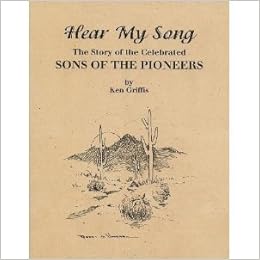
That's about all I was able to find out. You probably have a copy of Ken's book don't you, that you're referring to? [Hear My Song: The Story of the Celebrated Sons of the Pioneers by Ken Griffis.]


Yes.

Yesterday when I was talking to you before, when I was talking about transcriptions, about that they signed off on artists—that was the earlier transcriptions that they made.


The Standard transcriptions?

Yeah. And so, as I'm looking, I see these are The Symphonies of the Sage. Which I understand—in fact, I talked to Dusty Rogers yesterday—and I guess that Roy has rights to those. At least, he's claiming that he had rights to the Orthacoustic.  

My dad claimed that he had the rights to the Standard transcriptions, and I have the contracts where he purchased those for release. In fact, we have it in storage right now, all of the records.  


Did you work with Bear Family on their Sons of the Pioneers box sets?

No, I didn't, and in fact, I'm having a disagreement with them because it's probably true that [the Sons of the Pioneers] signed away on their artist royalties, but [Bear Family] still [has] a responsibility to pay songwriters' royalties and publisher royalties, and I don't think that's being done, because I'm the trustee for the original group of the Sons of the Pioneers and responsible for all the royalties. 

I've been asked by widows and heirs why I'm not doing something about that. When I talk with RCA or I talk with Decca about some of the stuff that goes on over in Europe, they say it costs more money to bring a lawsuit than you would get, and they just ignore it. When I tell the heirs and the widows that, they don't understand.


That's interesting, because Bear Family has a good reputation for paying royalties.

Well, there's quite a few bootleg operations that come out of Europe, and I'm not saying Bear Family is a bootleg operation, but they haven't been paying the copyright royalties. At least not on the Standard transcriptions. Hugh Farr's second wife is alive, and I send her royalty checks twice a year, and she's talked with the head of Bear Family. I forgot his name.


Richard Wieze.

Wieze, yeah. He says that he's willing to work with anybody, doesn't want to do anything wrong, and wants everybody to be treated fairly, and that's good that I heard that. I'll probably contact him once again, because the first time I contacted him, he never answered my letters. 

When anybody licenses through RCA or Decca, or when they compile anything, RCA's practice is to charge them as part of the lease agreement the songwriters' royalties and the artists' royalties, and [RCA] wants to be responsible for them, and so they pay that and they get it up front so the compiler doesn't have to pay that. He just pays it as part of his lease fee. And that's good, because when I get the royalties from RCA, for example, it shows me all the units sold and all the units that have come through compilations, and it doesn't necessarily list the name of the compilation, but I could tell by the songs that are out. I like that idea, and I wish [all labels] would all follow that. But there are some compilers out there that make deals with some labels and say "I'll pay it" and they don't. They end up not paying it.

That's as much as I could find out, and I know it's not very much.  


No, that's great. I really appreciate your efforts.

Wednesday, April 2, 2014

Music Weird interviews Sherrell Paris of the Paris Sisters

The Paris Sisters: Albeth, Sherrell, and Priscilla Paris


The Paris Sisters recorded one of Phil Spector's earliest hits—"I Love How You Love Me"—in 1961 before he created his famous Wall of Sound. The Paris Sisters' sound, unlike Spector's dense Wall of Sound, was whisper soft. 


Their sound didn't start out that way, though. They recorded a number of singles in the '50s for the Cavalier and Decca labels that sounded more like their heroes, the Andrews Sisters. 

The three Paris sisters are actual sisters. Albeth is the oldest, Sherrell is in the middle, and Priscilla ("Prissy") was the youngest. Priscilla died in 2004, not long before I talked to Sherrell. 

I interviewed Sherrell when I was working on Eric Records' reissue of the Paris Sisters' 1967 album Everything Under the Sun!!!  It's a great album, and the sisters' story is heartbreaking. 

Sherrell was really fun to talk to. After the Paris Sisters broke up, she became Bob Barker's assistant on The Price Is Right until 2000.

Here's the complete interview with Sherrell Paris from 2004. 


The story is that the Andrews Sisters "discovered" you, but you had already made some recordings.

We had made recordings for a local recording company. I don't know if they were ever released. Maybe they were.  


There were two. One was a Christmas single.

That's right. I recall that.


And the other was "The Bully Bully Man" [credited to Jimmy Diamond and His Sparkling Music].

"Bully Bully Man" or "Zorch Boogie." I think one was on one side and one was on the other.

We were in the audience watching the Andrews Sisters, hoping we could go back and meet them. Every day. We even cut school. We went every day and sat there to watch them. And they finally noticed us.  How could they not?  


And that was '54?

You know, I don't have the exact year. I honestly don't.


So you probably don't remember what year the Cavalier singles were made.

My goodness, no, Greg. I don't want to remember the years!


"Bully Bully Man" was a promotional tie-in with a local disk jockey.

It was. I don't know which disk jockey it was. I don't think it was Bill Balance—he came later.  Was it Don...? He was someone who was either a local disk jockey or on a local television show, and he was a little bizarre for that time. He was different. We had done his show a lot and that was all connected with "Bully Bully." [It was Red Blanchard.]


You were the middle sister.  How far apart in age were you?

Priscilla and I are only a year apart, and Albeth is a few years older. That's all you're getting!  Albeth sort of took care of us when we would go on the road and travel and all that. People always assumed I was the oldest because I was, like, 5' 7" at ten, and then they thought I was going to go on forever.


That helped you pass for adult.

And we did that. If you saw the pictures I sent to [Bill Buster of Eric Records] last night, we would wear the bustier tops—of course they were padded—and makeup, and our hair, which had always been long, in buns, and tried to look much older for a long time. We have never not worked.  We were working at five, six years old. We were already dancing and working and doing shows.


You skipped your childhood.

We did. And I know to Albeth and myself we were fine with that. Going to [places] after school or being with friends or playing in the street—we didn't do any of that. We used to come home and stand at the piano and rehearse and sing and do our scales. I loved the fact that it was different.


You didn't have any ambivalence?

No. No. And I know that Priscilla felt she missed a lot of her childhood and youth, but you never can really go back. You just say, "This is the way it was," and we gained something else from it. For me, I thought that we gained so much more from not following in the normal routine. And, who knows? The end isn't here for me yet, so I may change my mind.


That isn't Priscilla singing lead on the Decca singles.

I don't think she was. That was something that no one knew because when we very first started singing, we were dancers first. Bill has some of those pictures. I sent him pictures of us in leotards and dancing. Priscilla was so young she couldn't even sing. She kind of just strutted around. I did a lot of leads on the Decca records and so did Albeth. It was always a slightly different sound. The younger, more youthful, sweet sound came with Priscilla when we started doing the soft sound with Phil Spector.   


Did the Decca singles do anything regionally?  Did you gain any local notoriety?

There was some with it, because we were starting to do a lot of the veterans hospitals and camp shows. So, to the local area—like we did Camp Stoneman and Treasure Island, the Presidio up by San Franciso. They might have been only local hits.  


Then you moved to Gregmark. Priscilla said she never sang in that whispery style until Phil Spector encouraged her to do it.

She hadn't. We sang more like the Andrews Sisters.  


She said he coached her. Were you there for that?

Absolutely. He would come to our home and we would sit out on the front steps in the sun with his guitar, and he had all of us do it, and he was looking for that certain sound. He tried all of us. Of course, the younger singer was the closest he got to that sound.


On some recordings you all sang in that style.

Oh, we did. We learned it. It was called the "soft sound" at that time. The big band sounds were out by then.


The Andrews Sisters themselves weren't selling many records at that time.

They were basically way retired by the time we met them. But we did two of their songs. We did "Rum and Coca Cola" and "Roll Out the Barrel," and we did it in the Andrews' three-part harmony. That's when they finally called us up on stage.  

I don't know if you remember the bandleader—I think it was Dick Schoen—he was married to Patty. [Patty was married to Walter Weschler.] That's who was the bandleader. And our mom came out on stage and had his pianist move over, and she sat down and played it, and the band followed her. That was really the start. There was an MCA agent in the audience and he signed us up, and we never missed a day of work.


What about the famous Paris Sisters lost album? Wouldn't it have mostly contained the singles? What was on the tapes that were lost?

From what we can remember....  That was such a heartbreaking point that I don't think we stayed with it or labored with it much. We tried to put it to rest and move on. They were songs that were all similar to "He Knows I Love Him Too Much," "By My Boy," "Let Me Be The One." The album would have been the Gregmark/Phil Spector soft sound.


But they were all new songs?  It was a completely original album?

It was a complete original album.


You don't remember any of the songs?

No. I think there was one called "Lonely Hearts." You know, I don't want to say. I don't remember. At this point, we didn't want a life filled with litigation. We'd had our share, trust me. We'd gone after and didn't want to bury our heads in the sand, but we were still in our teens and we wanted to get back to school, I wanted to go to a prom, that kind of thing. And it was right about that time that our father passed away, and it just changed the dynamic of everything. He passed away when "I Love How You Love Me" hit the Billboard charts with a red bullet. We just got to tell him that, and he was gone shortly after that. I can remember sitting on the bed and talking to him.


How did Jimmy Bowen and Jack Nitzsche work together?

As far as I can remember, they worked well together. We did most of our rehearsing with Jack Nitzsche, as I recall. He used to wear these great big dark glasses all the time and we never knew why. Day and night.   


Nitzsche wrote the arrangements?

Yes.


Instrumental?

And the vocal. He did the vocal too. I remember us sitting at the upright piano in the home up on Sunset with Jack Nitzsche. He'd come up at night—that's why we thought it was so funny he was always wearing dark glasses.  

Casey Kasem, you know, did the byline on the album. How did that all come about? Jack Nitzsche was starting to be around a lot. Albeth had just gotten married about that time. Her husband knew Jimmy Bowen. In fact, they're still friends. We were being managed by Stan Irwin—he was Johnny Carson's manager. One thing led to another.


You say you won a Grammy around this time?

Talk with Albeth. We won some special award at a Grammy event. I have the picture. I thought that we won the Grammy for girl's singing group, or original girl group, or soft sound category—I don't know the category. Albeth was having a young romance with Clancy at that time and not paying as much attention. I was the one who kind of took care of the books and money when we'd go on the road. We had managers—I remember Stan Irwin very well.  We did the Johnny Carson show because of Stan Irwin. We just did it one time.  


Casey Kasem's liner notes say that you had an offer to do a TV series.

You know, we could have. I'm trying to think what the series was. The series could have been The Glass House. They were going to do a series called The Glass House and we did the album. We did a video on that too. That could have been the one. I don't have all the facts. We had another manager who managed the Lettermen, and his name was Jess Rand.  


The album Everything Under the Sun. Where'd the title come from?

I think it was because it was a bit of an eclectic album. It wasn't just any one sound. It was like a bit of everything. And I remember we wore those white linen dresses and daisies and the whole thing. I remember the dresses because I remember thinking that I always got the ugliest dress. Because I was the tallest. I had grown so much so soon, I don't think I became a swan until a few years ago.


Who picked the songs? Those were the first songs your recorded that came from within the group, right?

I'm pretty sure. Then we did the McGuire Sisters' "Sincerely."


Albeth said she thought Jimmy Bowen suggested that.

I think he might have.


Whose idea was it to combine "Sincerely" with the background vocal melody of "Be My Boy?"

It would have been Nitzsche. "It's My Party" was after Lesley Gore. My favorite was "Some Of Your Lovin'." It was great. On this, we were all singing—it wasn't just one voice.  


Particularly on "Born To Be With You."

That's how we started, with the three-part harmony. Basically, Albeth sang lead first, then I think I started singing lead. Even on "I Love How You Love Me," Phil pulled out little bits and pieces, like an "I" or just a word. You know, he had us all do it, but the youngest and purest voice was Priscilla.


Do you remember much about "It's My Party"? That's a very unusual recording. It's very slow and, toward the end, Priscilla's lead is strangely out of sync with you and Albeth. It has a strange, disconnected feeling.  

You know, that kind of would describe Priscilla, God bless her, and her life, that statement you just made. I don't remember it, honestly. It's been a long time since I've heard it.


"I'm Me" is very dark.

It's very, very dark. 

Did she grow up too soon? I don't know. You know, we were different.  She was—I don't mind saying this—she was absolutely striking. She was simply beautiful. When I look back on these pictures, it took me a long time to get to a certain point where I....  Priscilla was very beautiful, like little JonBenĂ©t Ramsey or Britney Spears. I mean, she had that look. You know what? It isn't always a benefit. There are many, many piranhas around, and she had her share.


Albeth said she thought "I'm Me" said a lot about Priscilla's personality.

It did. It did. I may go back and do some of her songs. It's not the point of having a hit record. I don't mean this to sound bourgeois or something. I wouldn't be doing it for money—I've had a wonderful career. It would just be more to kind of do it as a tribute. And Albeth went on to another career, also. And the one who didn't was Priscilla.  


Was there any resentment that Priscilla was placed on a pedestal?

Albeth and I never saw it that way. I know that might sound too good to be true, but we had performed so many years together. Albeth, as a young teenager, fell in love with Clancy. I was always into managing, and the entrepreneur, and doing things from a young, young age when I sold all my mother's jewelry. [Laughs] There wasn't resentment. 

Albeth and I—it was fine. It kind of evolved. It just evolved, because, remember, when we started, we sang and Priscilla couldn't; she kind of strutted in the middle back and forth on the stage. I don't mind saying that there was no doubt who was the prettiest of the three, and the most willowy, and the most fragile and all. Which kind of shows by her early demise. And it was Priscilla.  

I had my moments. I remember walking into a door into Gold Star once when they let the door slam in my face. Prissy had gone inside and I was like, "Okay, I don't like this."  


Did you miss singing lead?

That's the interesting part. As long as we were all still together, it was okay as long as it was going well. When we would do a live performance, we all would take leads, and get just as many accolades in a different way. Albeth had a Doris Day voice and I was more like Cher. We were just used to it being that way. The one who wanted to run and go on her own was Priscilla. She basically left us.  


Were you frustrated that your followups to "I Love How You Love Me" weren't selling as well?

Of course, but everything had become so convoluted with the Spector lawsuits and Gregmark and Lester Sill. We basically wanted to hold on to a normal life. We had great parents. We had great, great parents, kind of stable and normal. Would I say there was a loss when we didn't have a hit with another album? Of course, but we were on a whirlwind. At that time we were traveling the world, going to Japan, doing six shows a night in Army barracks, running all over the place.  


Wasn't that jeopardized by not having a hit?

No. We could have gone on and still been performing today. Priscilla did not want to. She finally got to a point—the one with the most troubled life was Prissy. She wanted to go out on her own. And the funny thing, unfortunately, is she didn't get the success that she thought she would have again. She tried.  


No one wants to feel that they've peaked early.

No, of course not. But especially when you've had so much attention and accolades for so many, many, many years. Priscilla had it all, but I don't think it was a good thing for her. It was painful for her when she couldn't repeat it. Just like the child star. We were all stars in our own right. We had all done it together. I know that Don Peak took Priscilla under his wing and tried to re-record her. So did Chuck Kay. I'm not sure who else. But it never happened again

Priscilla didn't realize we were her support group. We were her two anchors that kept her on the ground. We weren't her stumbling block to having the success come again. When we'd go on the road and do shows, we performed with George Burns, we performed with Elvis in Vegas, with Rowan & Martin on the road. We had great success as a trio. But Priscilla, because of the records, always wanted to go on her own.  


In 1976, Jack Nitzsche, when asked about the Paris Sisters, said, "Please don't remind me about them." Why would he say that?

Yeah. [Laughs] Priscilla, at that point, wanted so badly to go on her own, that she became a little difficult. There were many, many times we became very close again. Prissy and I were very, very close. I went back and lived with her for a month last year in Paris, and we walked and we talked and were arm in arm, and we laughed, and she said, "Okay, Shasha,"—Priscilla called me—"I know everybody thought you were the big oaf and just there because," God, I was so tall and everything!  And gangly! 

And she said, "You went on to a different type of life." I don't want this interview to be about me, but Albeth and I really went on to much more success in a different field. In 23-24 years with CBS, I sang all the time on different shows for Mark Goodson. And I sang "I Love How You Love Me," and I sang it just the way we did it, and it would bring applause and great memories, but I wasn't doing it for a career.  

Then, I was, like, doing it for Mark Goodson for his 70th birthday. And I think that I reaped so much more benefit from the hit record than Priscilla did. I think if Nitzsche said that, those were the years that she wanted desperately to step out on her own. Maybe she felt we held her back—I don't know, because we never knew. We never knew she was thinking that way.  We knew she was troubled. She received all the attention from Phil Spector and Nitzsche and Don Peake and Chuck Kay and just everyone out there in the business.  


Did she have any trouble convincing them to let her cut her own songs?

I don't know. I have a feeling that she did. They were all pretty deep and the world wasn't ready.


Some people think that her songs are the highlights on the album.

It's possible. She wrote more that were not recorded, but they were very, very dark.


How did you feel about performing her songs?

I loved her writing. I had to become very independent with doing my own thing from a very young age. I think that gave me strength. Priscilla never got to that point. She always remained very fragile. When I was with her in Paris, and she would come and stay with me, we'd have a huge tub, so we'd get into the bathtub together and talk, take a bubble bath, or get into the jacuzzi. We'd put on some music. I'd take a glass of wine. Prissy never drank.  


It sounds like you and Albeth were the Broadway, the-show-must-go-on types and Priscilla was the tortured artist.

You know, I didn't know that it sounded that way, but that is it.  


You came out of that vaudeville tradition that emphasized showmanship, stagecraft.

Right. You're not late, you all dress alike. We did our thing. We didn't give the bandleader a bad time. 

That's right. We were old school. Especially Albeth, more than I was. In fact, Albeth went on to do some review in town, and she did Kiss Me, Kate. She did all those. This was after we broke up. In fact, she worked with Loretta Swit in the same review company, and Gavin McCloud was in it. You're right—that was very astute. Albeth and I are still that way.

She went on singing, became quite an accomplished artist. I have two guitars here, and I said, that's it—they're antique pieces. But Priscilla played every night. She played and sang for me when I was in Paris.  


She had that drive.

But she was tortured. We don't know why. Albeth and I... Was it too much attention, too much suiters, too young? Possibly. Too many broken hearts?  

I'm going to tell you the truth. If these were to be a hit now, and hopefully they will be, something will happen. 

It's a wonderful thought. I don't think Priscilla could have handled it. She tried. She went on and did so much after. And Albeth went on to another career and I went on to Mark Goodson Productions. To get that job, I had to take my resume that said we sang here and we sang there, and I changed it to read that I did production here and production there. I think I was with the company 10 years before they found out.  

Albeth had a wonderful, successful marriage. My husband—we had a good marriage. He passed away.

Prissy did not. She was married again—she has two wonderful sons, but she never got solid roots again. She loved her music. When she left us, she just said, "I'm done." We had just signed a contract to do the Johnny Carson Show for 10 times, and she left.


So she left you in a bind?

Well, she had said she had told Stan Irwin that she would only give him a year, and we didn't know that. Stan told me that years later. Al and I understand—we really do—that's what she had to do. She was searching for that single again. Would I be talking this openly if she were alive? Probably, but you'd probably hear a different version from her. [Laughs.]  

She did the best thing. It wasn't the best thing for her, because we were her support. I know that. I handled the money and the books and Albeth took care of the hotels, you know. Prissy didn't have to worry. I hired five musicians and ended up back in Vegas and went on my own and sang solo for probably eight years and loved it. And it was enough for me.           


Here's Sherrell singing "I Love How You Love Me" in 2011.