Thursday, November 27, 2014

12 Thanksgiving songs: A holiday playlist


Unlike Christmas and Halloween, Thanksgiving doesn't inspire much holiday music, and no attempts at writing a Thanksgiving standard have achieved much commercial success.

When I hosted Rhythm Ranch, a thematic oldies show on WFHB-FM, I would often program special shows for the holidays, but I always struggled to come up with songs for Thanksgiving. For Thanksgiving—unlike many other holidays—I was never able to do more than a set or two of Thanksgiving-related songs. Programming an entire two-hour show of Thanksgiving music was beyond the limits of my knowledge and my record collection. 

Today on Music Weird, I have compiled a short playlist of songs for Thanksgiving. Some of them are straight-up holiday tunes and others are a stretch. Only a few of them are very widely known or well remembered.


1. Gene Autry – "Guffy the Goofy Gobbler" (1950)


Singing cowboy Gene Autry recorded the Christmas classic "Rudolph the Red-Nosed Reindeer" and struck gold. Afterward, he recorded a lot more holiday music, but none of it matched the success of "Rudolph." Autry's Thanksgiving entry, "Guffy the Goofy Gobbler," is practically "Rudolph" with new lyrics (both were co-written by Johnny Marks). The flip side of the record had another Thanksgiving tune called "Little Johnny Pilgrim." Billboard's review of the record described the latter as a "word-heavy Thanksgiving song [that] tells the historic story vaguely."


2. Lawrence Welk & the Lennon Sisters – "Thank the Lord (For This Thanksgiving Day)" (1959)


John Gary also recorded this song in 1959. 


3. Perry Como – "Prayer of Thanksgiving (We Gather Together)" (1952)


Despite the title, this sounds like a Christmas record, mainly because of the choir. 


4. Little Eva – "Let's Turkey Trot" (1963)


This dance song was written by Gerry Goffin and Jack Keller, even though some copies of the 45 credited Carole King instead of Keller. The song incorporates the call of the wild turkey—"gobble"—into its nonsense background vocal chant and became a Top 20 hit. 


5. Chris Rock – "Nike Turkey" (1991)


Chris Rock performed this Thanksgiving parody of "Parents Just Don't Understand" by DJ Jazzy Jeff & the Fresh Prince on Saturday Night Live.


6. Ohio Players – "Jive Turkey" (1974)


Not a Thanksgiving song, but it mentions turkey, so it'll do if you're scraping the bottom of the roasting pan to find songs for a Thanksgiving playlist. The song is actually about a jilted lover.


7. Johnny Cash – "Thanksgiving Prayer" (1997)


Johnny Cash performed the song "Thanksgiving Prayer" on an episode of the television show Dr. Quinn, Medicine Woman. I would hate to be the actor in a scene like this one who has to awkwardly sit and approvingly look on as someone else sings. Everyone who ever co-starred with Elvis in his movies had to do that on camera a few times.


8. Adam Sandler – "The Thanksgiving Song" (1992)


Another song from Saturday Night Live. This song was released to radio as a promotional single and actually reached #67 on Billboard's Hot 100. Today, Rolling Stone deems it a "Thanksgiving classic," but the bar is pretty low for that title, since the world of Thanksgiving music doesn't have a song like "White Christmas" to compete with.


9. Arlo Guthrie – "Alice's Restaurant" (1968)


This 18-minute long story-song about some goings-on "two Thanksgivings ago" took up the whole first side of Arlo Guthrie's album of the same name. Many people listen to this song every year as part of their Thanksgiving tradition.


10. Cousin Emmy – "Turkey in the Straw" (1965-66)


This traditional song isn't a Thanksgiving song, but it mentions turkeys, at least in the vocal versions. Here's an instrumental rendition by Cousin Emmy in which she performs it with her face. I'm not sure of the exact year that this clip was filmed, but it is from Pete Seeger's Rainbow Quest television show, which aired from 1965-1966. Homer & Jethro recorded a version of this song as "Chicken in the Pan." 


11. George Gobel – "Thanksgiving Song" (1955)


George Gobel introduced the song "Thanksgiving Song," written by Farlan Myers and Hal Levy, on television's The George Gobel Show in 1955. (Levy taught at UCLA and co-wrote Gene Vincent's "Blue Jean Bop.") Afterward, Dinah Shore would perform "Thanksgiving Song" regularly around Thanksgiving. I couldn't find a recorded version to link to.

George Gobel


12. The Clickettes – "Jive Time Turkey" (1958)

A story about a wolf who tries to obtain a fat turkey on Thanksgiving. 


Bonus song: Ira D. Sankey & Fanny J. Crosby – "A Hymn of Thanksgiving" (1899)

Gospel singer and songwriter Ira D. Sankey was dubbed "the sweet singer of Methodism." Published in 1899, Sankey's "A Hymn of Thanksgiving" was a collaboration with the blind hymnodist Fanny J. Crosby. No audio.


Saturday, November 15, 2014

What are "auto-generated by YouTube" music videos?


Update (March 22, 2016):

When I wrote this blog post a year and a half ago, no information about YouTube's auto-generated videos existed online. As a result, this post was part research and part speculation. Over time, some new information has come to light, but I never revisited the topic. In brief, YouTube obtains these audio tracks from digital music distribution services like CD Baby. When you sign up for CD Baby and similar sites, you're given the opportunity to choose which streaming sites (or which kinds of streaming sites) your music will be sent to. YouTube is now one of the sites where your music might end up.

When I—any many other people, apparently—signed up for these services years ago, YouTube wasn't considered a "streaming music site" like Spotify, and YouTube also wasn't creating its own videos that incorporated other people's music. So when these videos first appeared, a lot of people were surprised and even upset. To me, a site like Spotify that streams audio tracks seems different from a site that streams videos and might elect to embed your audio within a video. But regardless, YouTube has become one of the most popular sites for music listeners. If you check your CD Baby (or whatever) account, you'll see the revenue from the auto-generated YouTube videos alongside the revenue from Spotify, iTunes, etc.


I was surprised recently when I saw that several of my recordings had appeared as music videos on YouTube. All of the videos look the same: Each one, in addition to the audio of a song, includes an image of the album art and some text that provides the artist name and album title. The bare-bones descriptions that accompany the videos provide composer and copyright information and the statement "auto-generated by YouTube." What are these auto-generated music videos on YouTube, I wondered, and how are they created? 

A few years ago, YouTube introduced auto-generated channels, which are automatically created collections of videos related to specific topics. Google's support pages say that the auto-generated YouTube channels are created by algorithms that "collect trending and popular videos by topic." As with any other user channels, you can subscribe to the auto-generated channels "and stay updated on new videos" within a topic category.

YouTube has had these auto-generating channels since at least 2011, because WebProNews reported in 2012 that the channels had been around for over a year.


Auto-generated videos take the auto-generated channel concept a step further: Instead of simply compiling existing user-uploaded content by topic, YouTube is now creating the videos themselves—automatically. So far, YouTube has auto-generated videos for four of my recordings, all of which are taken from the 2014 February Records EP Way Last June.

How does YouTube select the content for these auto-generated videos?


The Google support pages say that that the auto-generated channels are "created when YouTube algorithmically identifies a topic to have a significant presence on the site." Presumably, the algorithm for creating the auto-generated videos also might be based on search terms and web traffic patterns, but not necessarily. It appears that all of the music for the auto-generated videos has been taken from Google Play, iTunes, and Amazon. 

The channel in which these music videos appear is blandly named "Various Artists – Topic," which doesn't seem like a topic that many viewers would subscribe to, but almost 500 people have subscribed to one of the two auto-generated YouTube channels that has this name. The second, identically named channel has about 50 subscribers as of this writing. The "about" section of the second channel even provides a helpful definition of the term "various artists," in case someone doesn't know what that means. 

Although a "subscribe" button appears below the name of the channel (which appears below the video), it didn't work for me. When I clicked on it, I got a message that said, "This channel is not available." I had to perform a Google search to find the landing page for the channel. It's pretty boring. It looks like something that was automatically generated.


There are now approximately a gazillion of these auto-generated videos on YouTube, many of which have received no views. The prospect of an endless proliferation of automically generated videos reminds me of the Jeff Carlson novel Plague Year, in which self-replicating, flesh-eating nanobots spread inexorably and nearly wipe out humankind. Just like these videos might do! If content is king, as Bill Gates said, then the king has become a mindless automaton.

Is it okay for YouTube to do this? 


I don't really mind that these videos of my recordings exist, but not everyone will feel the way I do. Artists could have a number of legitimate objections to the videos. For example, if artists had created or intended to create videos of their own, these auto-generated videos would compete with the official videos. Artists might also object to the design aesthetic of the videos or the song selection.

But the biggest potential issues are copyright and compensation. Artists receive no royalties from these videos, and YouTube posts the videos without permission from the copyright owners. It's strange that YouTube—which suspends users' accounts and deletes videos if it detects copyright infringement or receives complaints from copyright holders—now trawls the internet for music and posts it without permission on an increasingly massive scale. Class-action suit, anyone?

To its credit, YouTube has a program called Content ID that reportedly has paid out $1 billion to copyright holders. The Content ID program requires copyright holders to locate infringing content and then file claims in order to delete it or monetize it. It's hard to imagine that people would accept a rights-management model like this one in other areas, such as the publishing industry. What if you could reprint authors' books with impunity until they noticed it and said something?


Sunday, November 9, 2014

New release documents the birth of orchestral rock


On November 18, the Complete 60s label will release Rock & Roll Symphony No. 1: A 1959 Stereo Concert, the first (and likely to be the only) anthology to document the brief fad for setting orchestral instrumentals to rock rhythms.

The rock rhythm we're talking about here, to be specific, is the rock and roll triplet, which originated in R&B but then became a ubiquitous feature of pop and rock recordings. Bandleaders had two goals in pairing orchestral instrumentals with rock rhythms: The first was to sell orchestral music to teenagers, and the second, more activist goal was to uplift the youth by providing them with "better," more sophisticated music than the brainless rock and roll that kids otherwise listened to (in the bandleaders' view—not mine). Enoch Light, in the liner notes he wrote for his album With My Eyes Wide Open I'm Dreaming, makes this point very explicitly: “Rock and roll must be applied to better melodies than it usually is.” And 101 Strings’ David L. Miller, in the liner notes of Back Beat Symphony, said, "Too often, teenagers “must be satisfied with badly written songs with borderline obscene lyrics.”

I wrote the liner notes for this CD and was excited to work on the project, because I've been a fan of this music for a long time. The album contains the complete 101 Strings album Back Beat Symphony, which appears on CD for the first time here. This album and its single, "Back Beat Symphony," were more successful than the charts suggest. Billboard reported that after Dick Clark played "Back Beat Symphony" on American Bandstand, the single sold 400,000 copies. It made the Top 40 in Cleveland, Buffalo, and Pittsburgh but didn't register on the national charts. (Music Weird previously wrote about 101 Strings' unusual discography here.)

The anthology also contains the stereo debut of Frank Pourcel's French Fiddles' five-million-selling orchestral arrangement of the Platters' "Only You (And You Alone)," which was so successful that it even reached the R&B Top 20 in 1959. Despite the title, the anthology isn't confined to recordings from 1959. A few other later recordings in the same vein are also included: Percy Faith's "'The Theme from 'A Summer Place'"—the biggest hit of 1960—and Raymond Lefèvre's hard-to-find hit "Soul Coaxing (Ame Caline)" from 1968.

All of the recordings were carefully remastered in wide stereo by a team of engineers and stereophiles. Here are some particulars on some of the other contributors to the brief fad for orchestral rock, some of which are featured on Rock & Roll Symphony No. 1: A 1959 Stereo Concert.

Enoch Light  and the Light Brigade

Light's album With My Eyes Wide Open I'm Dreaming contained the 1959 hit of the same name and other orchestral rock tracks in a similar vein. It was Light's only orchestral rock album; he otherwise recorded ultra-high-fidelity stereo showcase albums like the Persuasive Percussion series. 


The Knightsbridge Strings

The Knightsbridge Strings were a studio ensemble of London musicians. Their arrangements were penned by Reg Owen, who had a big hit under his own name with “Manhattan Spiritual,” and Malcolm Lockyer. The Knightsbridge Strings had orchestral rock hits with instrumental renditions of "Wheel of Fortune" and "Cry," both of which were included on their album The Strings Swing.


Ray Martin – The Rockin' Strings of Ray Martin

Features orchestral arrangements of pop standards, like "Who's Sorry Now?" and "Blueberry Hill," with rock rhythms. 


Raymond Scott – Raymond Scott Presents the Rock 'n Roll Symphony

This anomalous 1958 album by Raymond Scott is similar to Ray Martin's: It contains orchestral rock renditions of oldies like "Stardust" and "How High the Moon." A poorly mastered reissue is available on Amazon.


The Back-Beat Philharmonic

The Back-Beat Philharmonic, which released only one single, was actually the Islanders—the duo of Frank Metis and Randy Starr—who wrote and produced the 1959 hit "The Enchanted Sea." In 1961, Metis and Starr recorded this rock version of Beethoven's Fifth Symphony as "Rock and Roll Symphony" under the name Back-Beat Philharmonic. The recording, poorly mastered from vinyl, is included on the anthology Axes, Saxes, Skins & Ivories: 25 Instrumental Rareities [sic] Volume 2.


Thursday, November 6, 2014

The waltz was the twerking of the 1800s


Music Weird previously wrote about the doomed effort to revive the waltz among teenagers in the 1950s. Back then, the waltz seemed genteel and old fashioned in comparison to rock and roll, but it wasn't always that way. In fact, the waltz was once the "dirty dancing" of the 1800s, like twerking is today.

You could even argue that the waltz was worse than twerking, because twerking is likely to be a passing fad, but the waltz hung around for ages to torment moral authorities.

The waltz is rooted in gliding dances of the 16th century in which dancers held each other close, which the was the largest part of the controversy surrounding the dance. By the mid 17th century, a dance called the waltzer was being danced in Germany and Austria. By the early 18th century, the dance had spread to Britain.

Today, Music Weird compiles over 100 years' worth (!) of grousing about the moral blight that was the waltz.


1771

In the German novel Geschichte des Fräuleins von Sternheim by Sophie von La Roche, one of the characters described the waltz as follows:
But when he put his arm around her, pressed her to his breast, cavorted with her in the shameless, indecent whirling-dance of the Germans and engaged in a familiarity that broke all the bounds of good breeding—then my silent misery turned into burning rage.

1794

The book Mozart: A Cultural Biography reports that the Queen of Prussia "averted her eyes when she beheld the waltz at its introduction to the court in 1794," and that Montaigne "stared in astonishment at couples turning away as they danced in close embrace" in Augsburg, Germany.


1812

The Universal Magazine of Knowledge and Pleasure reported on an English duel that resulted from a disagreement over the waltz:
A dispute arose, whether the Waltz was an indecent dance ; and till this attempt at murder, we did not imagine that a single Englishman would stand up in its defence. To settle this dispute the parties took to their pistols, and we are glad to say returned unhurt ; but had the vindicator of the Waltz murdered his antagonist, we should not have been the more reconciled to this indecent exhibition from Germany.

1816

When English dancers danced the waltz at the Prince Regent’s Grand Ball in 1816, The Times of London wrote:
We remarked with pain that the indecent foreign dance called the Waltz was introduced (we believe for the first time) at the English court on Friday last…. [I]t is quite sufficient to cast one’s eyes on the voluptuous intertwining of the limbs and close compressor on the bodies in their dance, to see that it is indeed far removed from the modest reserve which has hitherto been considered distinctive of English females. So long as this obscene display was confined to prostitutes and adulteresses, we did not think it deserving of notice; but now that it is attempted to be forced on the respectable classes of society by the civil examples of their superiors, we feel it a duty to warn every parent against exposing his daughter to so fatal a contagion.
 
1843

The New World ran a piece that appealed to readers' patriotism in hoping that "with the feminine dignity and simplicity that so well becomes the daughters of a Republic like our own, they will discard the waltz as a dance revolting to modesty, and unfavorable to virtue...."


1866

Belgravia magazine printed the following commentary on the waltz:
We who go forth of nights and see without the slightest discomposure our sister and our wife seized on by a strange man and subjected to violent embraces and canterings round a small-sized apartment—the only apparent excuse for such treatment being that is done to the sound of music—can scarcely realize the horror which greeted the introduction of this wicked dance. 
  
1877

William Rulofson, under the pseudonym William Henry, published the book The Dance of Death in 1877 to show society "what a loathsome ulcer festers in its midst." He described the male waltz dancer as one whose "eyes, gleaming with a fierce intolerable lust, gloat[s] satyr-like over" his female dancing partner.

In an 1878 review of the book, Scientific Farmer said:
We thought, on reading the title, that we were to be treated to a dance by the author, as the title indicates ; but we soon found that the author was not writing his own dance-music, but finding fault with the dancing of others. It is probable that dancers will not be converted into non-dancers by reading this book, but those who have not yet learned the art may receive consolation from its pages. We agree, however, with the author, in his continuation and conclusion, that the modern waltz may be the instrument of evil. The book is finely gotten up, and is creditable to its publishers. It is strongly and fearlessly written, with an intensity of expression that is almost startling.

1895 

The Lutheran Witness ran a piece on dancing in which numerous moral authorities expressed their views. 

Rev. B.M. Palmer of New Orleans said:
Promiscuous dancing between the sexes is essentially voluptuous and demoralizing. The waltz—a species of dance I do not hesitate thus publicly to denounce as undisguisedly licentious.

Howard Crosby said:
The foundation for the vast amount of domestic misery and domestic crime which startles us often in its public outcroppings was laid when parents allowed the sacredness of their daughters' persons and the purity of their maiden instincts to be rudely shocked in the waltz.

Bishop Cleveland Coxe said:
The gross, debasing waltz would not be tolerated another year if Christian mothers in our communion would only set their faces against it and remove their daughters from its contaminations and their songs from that contempt of womanhood and womanly modesty which it begets.


Monday, October 20, 2014

Rock 'n' roll etiquette: Celebrity books on manners from 1959-60


In the 1950s, amid widespread concerns about the negative influence of rock 'n' roll on teens, about juvenile delinquency, and about young people's moral lassitude in general, some of the respectable faces of rock 'n' roll wrote zany books of etiquette for teens. 

Parents could take comfort in knowing that their children were being schooled by some of the most successful and clean-cut pop celebrities of the day. Dick Clark was a swell disk spinner on TV, so he'd probably be the best person to teach your daughter about menstruation. Pat Boone drank a gallon of milk a day for health, so he should teach your daughter how to comport herself around boys.

These celebrity advice books weren't confined to the '50s and early '60s. I used to have a copy of a similar book by Susan Dey (of The Brady Bunch), which was published in 1972.

Today on Music Weird, we'll look at five rockin' and rollin' books of moral instruction.


Dick Clark – Your Happiest Years


Parents "have a strange way of being right most of the time," Dick Clark wrote in his 1959 self-help book for teens, Your Happiest Years, which covers—as Kirkus Reviews wrote—"the entire familiar range of adolescent problems—puberty, belonging, family conflict, dating, makeup, going steady, manners, the battle between the sexes, personality, and finally, reluctantly, teen-age marriage." 

Clark was, in the words of Arnold Shaw, "the great tranquilizer of the era, reassuring parents by his suave manner that rock 'n' roll was not bad...." As the "world's oldest teenager," Clark was uniquely positioned to provide teens with some low-key advice about menstruation and grooming. His lacquered hair was always perfectly sculpted, so his authority on the latter was unquestionable. 

You can read some quotations from the book here.


Pat Boone – Twixt' Twelve and Twenty: Pat Talks to Teenagers


Pat Boone was the "good boy" of rock and roll, and the second-biggest hit-maker of the '50s after Elvis Presley. Pat was a paragon of virtue, sporadically championing "good music" (when he wasn't covering other artists' rock hits) and generally setting a good example for the kids. When he covered Fats Domino's "Ain't That a Shame," he wanted to correct the grammar and sing it as "Isn't That a Shame," but his record label wouldn't let him. Too bad.

It's fun to make jokes about Pat Boone, but I'm a fan. I have the two big Bear Family box sets that compile his recordings through 1962, and I saw him live several years ago. He put on a great show. 

Boone wrote two advice books for teens: 'Twixt Twelve and Twenty (which was also the title of one of his hit songs) and Between You, Me and the Gatepost: A Heart-to-Heart Message for Teen-agers, which is featured next. Despite my fandom, I find 'Twixt Twelve and Twenty to be extremely irritating. The voice is cornball and the advice seems random. It's like sitting and listening to Pat pontificate for 176 pages. Oh, wait—that's exactly what the book is.

Here are a few quotations from 'Twixt Twelve and Twenty: 
No matter what the other girls tell you, I say, if you want to be attractive to boys always look your best! Let the other gals wear Dad's shirts and sloppy blue jeans—you'll have the guys all to yourself.
Kissing for fun is like playing with a beautiful candle in a room full of dynamite! And it's like any other beautiful thing—when it ceases to be rare, it loses its value and much of its beauty. I really think it's better to amuse ourselves in some other way. For your own future enjoyment I say go bowling, or to a basketball game, or watch a good TV program (like the Pat Boone Chevy show!), at least for a while.
Whether we've been spanked or not when we arrive at the teen age is entirely out of our hands. If we have been spanked, our reaction will determine whether we become "spanking" parents. It is simply one of the methods used to help children distinguish between right and wrong at an early age. And of course there are spankings—and there are spankings. There is the delayed spanking that sets in when you're too old to go across Mama's knee and have to wait until you get you home and lean over the bathtub. There is the angry spanking, and the loving spanking. My mother never gave "loving" spankings. I wouldn't know what they were. But hers weren't angry spankings either; they were intelligent and they were just. 


Pat Boone – Between You, Me and the Gatepost: A Heart-to-Heart Message for Teen-agers


Boone's second book for teens followed his first by only a year. But what more was there to say? 

It reminds me of Lawrence Welk's second autobiography, Ah-One, Ah-Two!: Life With My Musical Family. After Welk's first autobiography, Wunnerful, Wunnerful! became an unexpected hit, he was given the opportunity to write a second book. He didn't have much to say, though, so the most dramatic episode in the book is when someone gives him a ham and he doesn't know how he'll fit it on the plane. 


Connie Francis – For Every Young Heart: Connie Francis Talks to Teenagers


"Never wear slacks on a date," Connie Francis counseled teenage girls in her book For Every Young Heart. "I think slacks are an insult to a boy."

Francis seemed matronly even as a young woman, so she's just the kind of person you'd expect to deliver unsolicited advice about what to wear. 

I'd like to know how much content in these books (if any) was actually written by the nominal authors.


Patti Page – Once Upon a Dream: A Personal Chat with All Teenagers


Patti Page, the Singing Rage, was well past being a teen singer when she put her name on this advice book. She was in her 30s at the time, having started her recording career in the 1940s. 

Nevertheless, Page cut some rock and roll records. There's a pretty good bootleg CD of her rock-oriented cuts that is titled The Singing Rage Rocks. In 1959, a widespread belief in the music trade journals was that rock and roll was waning as teenagers' tastes matured and became more sophisticated. That trend boded well for traditional pop singers like Page, who theoretically would be able to start having hits again soon with the same kind of music they'd always made. It didn't quite work out that way for Page, though; she wouldn't have another Top 10 hit until 1965 (with the adult-contemporary ballad "Hush, Hush, Sweet Charlotte"), and then she defected to country music in the 1970s. 

In the book, Page has a lot to say about how girls should act and dress in order to get a husband:
If you will just remember that woman’s traditional role is to help a man make something of himself, you will realize that there is always the chance that you can help the drip of today become the man of the moment tomorrow.
You can read more quotations from the book here.


Friday, October 17, 2014

Hula-hoop songs of 1958-59


When the hula-hoop craze took off in 1958, the ensuing marketing (and buying) frenzy was compared to the Davy Crockett craze of 1955, which had every child in the nation wearing coonskin caps. In the grip of hula-hoop mania, county fairs held hula-hoop contests, novelty toy manufacturers sold wind-up hula-hooping monkeys, and recording artists piled on with records that were designed to cash in on the public's hunger for anything related to the hula hoop. The hula-hoop craze in music lasted only a few months, but hula hoops have been a standard item in toy stores ever since.
Although hoops like the hula hoop had been around for millennia, the Wham-O toy company introduced the plastic hula hoop in the summer of 1958. The toy's name coincided with a surge of interest in Hawaiian music and reflected the similarity of hoop users' gyrating hips to those of hula dancers.

Hula hoops were an instant smash and quickly became a benchmark of success in marketing. In 1959, a number of manufacturers optimistically touted their products as "the next hula hoop." In 1960, in advertisements for Ray Bryant's hit "It's Madison Time," Columbia Records described the dance of the same name as "the biggest epidemic since the hula hoop." Rolf Harris' "Tie Me Kangaroo Down, Sport" was also advertised in 1960 as the biggest thing since the hula hoop. None of these things was as big as the hula hoop, but the claim made for good ad copy.

The highest-profile hoop records were also among the first ones to appear. Georgia Gibbs recorded "The Hula Hoop Song," which gave her one of the last Top 40 hits of her career. The song was practically an advertising jingle for hula hoops and asserted that even 110-year-old people could use them. When I interviewed Gibbs, she was dismissive of "The Hula Hoop Song." "I had no say" in recording the song, she said, and expressed a dislike of novelty material in general. (She preferred to sing ballads.) Teresa Brewer covered "The Hula Hoop Song" and siphoned off some of Gibbs' sales. In France, Billboard reported, Gibbs' record was used "as an instruction guide to using the hoops."

Betty Johnson, who'd had an earlier novelty hit with "The Little Blue Man," cut "Hoopa Hoola (With a Hula Hoop)," which referenced a number of other hit songs of the day and reached Billboard's Hot 100. Steve Allen recorded a song called "Hula Hoop" and premiered it on his NBC-TV show in a lavish choreographed production. Maureen Evans gave hoop songs a whirl with her own version of "The Hula Hoop Song" and included a cover of Johnson's "Hoopa Hoola" on the flip side for good measure. 

Pop vocal music wasn't the only genre in which hula-hoop songs could be found. Johnny McDowell and Grady Boles recorded the instrumental single "Hula-Hoop Boogie" b/w "Beat of the Hoops." The recordings were probably given those titles to capitalize on the craze rather than to reflect any real connection with hula hooping. J.D. Orr and the Lonesome Valley Boys entered the ring with a country boogie that was also titled "Hula Hoop Boogie" but was a vocal number; the lyrics said that the hula hoop was overtaking rock and roll in popularity. The Platters, an R&B group, recorded "Hula Hop," and the Frank Woharowski Orchestra served up some hula-hooping polkas on the album Hula Hoop Polka (pictured at the top of this post). David Carr Glover wrote a beginner's piano piece, "My Hula Hoop," that was sold as sheet music in 1958.

The hula-hoop craze wasn't confined to the United States, either. A number of hula-hoop songs appeared around the world in 1958. In Germany, Angèle Durand recorded a German-language version of "Hoopa Hoola" as "Hula Hopp," and rocker Ted Herold offered "Hula Rock (Roll, Rock 'n' Roll That Hula Hoop)." Austria's Hedi Prien (later a member of the Honey Twins) recorded a version of "The Hula Hoop Song" titled "Hula Hup," and the Netherlands' Rita Corita recorded a Dutch-language version titled "Hoela - Hoep!" In France, Annie Cordy recorded "Houla Houp." In Finland, Olavi Virta released a two-sided hula-hoop single that included the song "Hula Hula Hula Hula Hula Hoop." And in Italy, Teddy Reno released a two-sided hoop disc that included the song "Tempo Di Hula Hoop."  

As Christmas 1958 approached, the inevitable hula-hooping holiday novelties hit the shops. The Pixies (with Thurl Ravenscroft!) had "Santa's Too Fat for the Hula Hoop," which was released in December, with Thurl providing the booming voice of Santa. In the Chipmunks' chart-topping hit "The Christmas Song," released the same month, Alvin the Chipmunk expressed his desire to receive a hula hoop for Christmas. The Night Owls released "Loop the Hoop" on the NRC label, and Billboard's review called it a "[s]omewhat tardy" entry in the hoop sweeps.

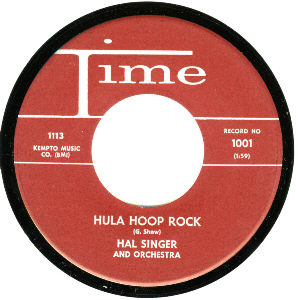
The fad for hoop songs had mostly run its course by the end of the Christmas season, but a handful of hula-hoop records trickled out in early 1959. Hal Singer released "Hula Hoop Rock" on Time Records in the U.S., but most of the remaining hoop records appeared in other countries. Ana Maria cut "La Canción del Hula-Hoop," and Giorgio Gaber cut a version of "The Hula Hoop Song" for Italy. Thereafter, hula-hoop records were few and far between. Dave "Baby" Cortez released "Hula Hoop (Shoop Shoop)" in 1967, but—musically as well as thematically—it seemed like a song that had been recorded years earlier.

I can't immediately think of another popular toy that inspired such a rash of novelty songs. Neither the Slinky, the Frisbee, pet rocks, nor lawn darts made appreciable dents in popular music (although Ed's Redeeming Qualities recorded a great song about lawn darts). The actual "biggest epidemic since the hula hoop" in music would be the Twist craze, which dominated music from 1960-62 and continued to generate the occasional hit for two years thereafter.


Wednesday, October 8, 2014

The Traits' "Nobody Loves the Hulk": An interview with Rosalind Rogoff


"Lucky is the collector today who finds a 45 copy of the obscure 1969 garage/psych record, 'Nobody Loves the Hulk' (QNS 101)," writes Mark McDermott in the book Web-Spinning Heroics: Critical Essays on the History and Meaning of Spider-Man. Music Weird recently tracked down the song's composer, Rosalind Rogoff, to find out the story behind this sought-after comic-book novelty record. 

Recorded by a band called the Traits (not Roy Head's band), "Nobody Loves the Hulk" is surprisingly well remembered when you consider that Rogoff sold it exclusively through an ad in the back of Marvel comic books, and that only a few hundred copies sold during its initial run.

A few videos of the song appear on YouTube (one of them is below), and the record is featured in Kirk Demarais' extremely entertaining book Mail-Order Mysteries: Real Stuff from Old Comic Book Ads!. It’s also included in two anthologies of '60s psychedelic and garage rock: volume 21 of the Pebbles series and volume 4 of the Glimpses series.

The song was later recorded by at least two other bands. Swedish garage rockers the Maggots recorded it in 2006 for a single that was issued with two different sleeves, one of which is very similar to the Traits' original single. A free-jazz group, the Tight Meat Duo, recorded the song in 2007. 


The song is actually quite good for a comic-related novelty. It tells the Hulk's origin story, describes his physical appearance, and finally portrays him as a victim of the Establishment. The song even takes a subtle swipe at racism with the line "We don't allow no green skin people in here." For fans of the Hulk, it really captures the underdog status of the Hulk, whose uncontrollable rage made him more of a force of nature than a conventional superhero. The Traits' performance is great, and the overall quality of this mail-order item was much higher than that of the typical fare that was offered through comic-book advertisements, like X-Ray Spex and Sea Monkeys. 


Rogoff lived in New Rochelle, New York, in the late '60s and hired the Traits, a local garage band, to record the song. Around that time, the Traits also contributed a song called "High on a Cloud" to the compilation album Ran-Vell Records Presents Battle of the Bands Vol. 1. Ran-Vell was a label/studio in White Plains, New York. The album says that the Traits were from Pelham, not New Rochelle, but Pelham is only a couple of miles away from New Rochelle. The album lists the members of the Traits as:
Mike Carrol, vocals 
Don Chicherchia, guitar 
Bob Creaturo, guitar 
Jim Klieforth, organ 
Bobby Williams, drums
After giving up on the music business, Rogoff became a technical communicator and wrote a book about instructional design in the 1980s. Today she writes the blog San Ramon Observer and seems like someone I'd enjoy hanging out with if I ran into her at a Society for Technical Communication meeting. 

Music Weird's interview with Rosalind Rogoff took place between October 5-7, 2014. 


Tell us about the recording session for "Nobody Loves the Hulk."

The group that recorded the record was called "The Traits.” They were a high school garage band in New Rochelle, where I lived at that time. The high school band teacher gave me the contact info. I don’t remember the names of the guys in the band. There were five or six of them. I recorded the song at a studio in New Rochelle and the record was pressed by Capitol, which gave me the best price for 45s. 


What inspired you to create a Hulk-related novelty record? 

I was a nerd then and still am. I’m not as nerdy as the Big Bang Theory guys are, but I was very much into comics when I was in my twenties. My mother kept telling me to get rid of all the old comics I saved, so I sold them to some guys for $25. I knew they would be worth a lot more in a few years, but it made my mother happy. 


Did you sell the single only through comic book ads? 

I advertised it in Marvel Comics and had about 2,000 copies made. I sold a few hundred and donated a bunch to the Fire Department as Christmas Gifts and sold the remainder to a collectables store. Many were later found in a warehouse, but I don’t know what happened to them after that. I kept one copy for myself. It’s not terrible, but I prefer not to associate myself with it. It’s part of my unsuccessful, entrepreneurial past.

The original ad for "Nobody Loves the Hulk"


The book Mail-Order Mysteries describes the record as an "unauthorized" tribute to the Hulk. Did you get permission from Marvel to use the Hulk name and image? 

You will see credit given to Marvel on the record sleeve for permission to use the Hulk name and image. 


Did you play an instrument? If not, how did you communicate the song to the Traits? 

I wrote the music and lyrics but I didn’t play an instrument in the group. One of the guys in the Traits did the arrangement, but I don’t recall any of their names. I also recorded a song one of them wrote for them to use as a demo. I don’t have a copy of it.


The B-side was another song that you wrote called "Better Things." What's the story with that? 

“Better Things” was an anti-Vietnam war song, but could apply to any of the stupid wars we’ve had since.


"Nobody Loves the Hulk" is often categorized as a psychedelic/garage rock record. Was that the kind of record you set out to make? 

It’s certainly not psychedelic rock, or at least not on my part. I considered it a gag or novelty song and hoped it would catch on with Hulk fans and make a lot of money.


What kind of music were you listening to back then? 
 
I liked jazz and the great American songbook. I had a big collection of 78s of Duke Ellington, Louis Armstrong Hot 5 and Hot 7, Red Nichols, Benny Goodman, and Bix Beiderbecke. I wasn’t into rock at all back then. This was strictly an economic venture.


Did you know that other artists had recorded this song? 

I did not know it was ever recorded again. They [the Maggots] did a pretty faithful reproduction. My copyright expired in 1997. I didn’t renew it, so the song is probably public domain now. I received some small royalties from BMI for radio plays after I mailed copies around, mostly to college stations. I didn’t get anything after 1970. I’m not sure if I’m even still a member of BMI. I never renewed that either.