Tuesday, February 2, 2016

The #1 Elvis hit that Elvis hated


It was the last Top 10 pop hit that Elvis Presley had during his lifetime. Critics heralded it as Elvis's great return to rock 'n' roll. It became a #1 pop hit in Cash Box and a Top 40 country hit on the Billboard country chart. But Elvis hated it and disliked performing it. The song? The 1972 hit "Burning Love." 

Producer Felton Jarvis pushed Elvis to record "Burning Love," a song that recently had appeared as an album cut on an LP by R&B great Arthur Alexander. Elvis didn't like the song and didn't want to record it but cut it anyway at Jarvis's urging.

Mark P. Bernardo, in his book Elvis Presley: Memphis, says that Presley at that time was moving away from rock toward "bittersweet, melancholy ballads" because of his breakup with Priscilla, so he wasn't inclined to record rockers such as "Burning Love." But people close to Elvis said that Elvis's dislike of the song involved more than just its rock orientation.

For example, "Memphis Mafia" member Jerry Schilling said, "Elvis—who had close to a photographic memory when it came to books, scripts, lyrics—always insisted that he needed a lyric sheet to perform 'Burning Love.'"

"Elvis didn't want to record 'Burning Love,' didn't like it when he had recorded it, and sang it as rarely as possible afterwards," wrote Paul Simpson in The Rough Guide to Elvis.

Why was Elvis so unenthusiastic about this song that had revived his commercial fortunes? If you watch a lyric video of the song, I think it's pretty easy to see why. I like this song, but it sounds like it was written in five minutes. The lyrics have no logical order—you could rearrange the lines randomly without significantly altering the meaning, because most of them restate the same thought in different ways. The rhyme scheme is almost nonexistent, and it's hard to tell where the singer is supposed to put the stresses. In Elvis' version, you can hear on a few lines where he struggles to fit the line to the rhythm of the song. The song also weirdly repeats the word "flaming."


"Burning Love" was written by Nashville songwriter Dennis Linde, who recorded a version of it himself. Linde's voice, on his version, reminds me a bit of Loudon Wainwright, but some people think he sounds like John Fogerty. You might expect the songwriter's version to be definitive, but even Linde seems to struggle with where to place the stresses on some lines. (Listen to the "it's hard to breathe" line, for example.)

Whatever Elvis thought about the song, it was enthusiastically hailed by fans as a return to his rock 'n' roll sound, and the "hunk o' hunk o' burnin' love" refrain recalled Elvis's 1959 hit "A Big Hunk O' Love." And in this live performance, Elvis appears to perform the song in its entirety without lyric sheets or teleprompters.


Friday, January 22, 2016

"Roll Them Roly Boly Eyes": Eddie Leonard and the song that "started the decline of vaudeville"


"Roll Them Roly Boly Eyes" is the song that "started the decline of vaudeville," according to Joe Laurie Jr.'s 1953 book Vaudeville: From the Honky-Tonks to the Palace. This song is almost completely forgotten today but used to be very well known.


The Knickerbocker
The song was the title tune of John Cort's successful 1919 musical Roly Boly Eyes. The January 31, 1920, issue of The Independent described this musical as the "fascinating, tuneful, dancingest, altogether different musical comedy success" with a "snap, tuneful score and cast of New York favorites." It opened at Broadway's Knickerbocker Theatre on September 25, 1919, and ran through the end of the year, after which Cort took it on the road. 

"Roly Boly" is sometimes spelled "Roley Boley" (as it is throughout Laurie's book), possibly because the actress May Boley was in the cast of the show. But the sheet music and other materials from the original run of the show spell it "Roly Boly." The song title of "Roll Them Roly Boly Eyes" varies from source to source too; It is variously listed as "Roll Them Roly Boly Eyes," "Roll Dem Roly Boly Eyes," and "Roll Those Roly Boly Eyes."


Cort's musical was written to showcase the talents of Eddie Leonard, a blackface minstrel performer who composed the song "Roly Boly Eyes" as well as the most famous song in the show, "Ida Sweet as Apple Cider," the latter of which predated the show. "Ida" has been recorded by Eddie Cantor (who also performed in blackface in his vaudeville days), Frank Sinatra, Bing Crosby, Bill Haley, and many other big-name artists.

Leonard's blackface act was considered old fashioned even in 1919, but he was so successful that he wore a diamond-studded belt that was adorned with real diamonds and looked after by a guard.

The video at the bottom of this article contains the only audio recording of Leonard I've found. In it, he sings "Ida" in dialect with frequent interjections of "wa-wa-wa" and "oh-oh-oh" and "doodly doo." 

Leonard's oddball vocal style was frequently imitated by other performers. Al Schacht, the "Clown Prince of Baseball," did a vaudeville act with fellow baseball player Nick Altrock that is said to be the first act to feature "baseball clowning," and their grand finale was an impression of Leonard singing "Roly Boly Eyes." Billy Jones and Ernest Hare cut a record for Brunswick in 1922, "Eddie Leonard Blues," that references "Ida" and "Roly Boly Eyes" and imitates Leonard's vocal stylings. The California Ramblers recorded "Eddie Leonard Blues" for Vocalion. Ray Bolger (the scarecrow from The Wizard of Oz) did a brief impression of Leonard in this 1953 television performance. (The Leonard part begins at 2:06.) Bolger adds Leonard's trademark "wa-wa-wa."

Roly Boly Eyes was the apex of Leonard's career. Critics hailed it as one of his finest performances, and the songs lived on for decades. Leonard reprised "Roly Boly" and "Ida" in his starring role in the 1929 film Melody Lane, but the film was so poorly received that it ruined his prospects for a post-vaudeville life in Hollywood. Author Richard Barrios, in his book A Song in the Dark: The Birth of the Musical Film, described Melody Lane as "a fiasco, the first mammy picture to engender outright hostility from audiences as well as critics." Afterward, Leonard appeared in only one more film, playing himself (in blackface) in the 1940 Bing Crosby movie If I Had My Way.

Blackface minstrelsy endured, in a diminishing capacity, in Hollywood films until the early 1950s, particularly in the films of Al Jolson. In 1952, Teresa Brewer had a pop hit with a non-novelty remake of "Roll Them Roly Boly Eyes" that doesn't make any reference to Leonard's vocal mannerisms. By the time Brewer recorded her version of the song, things had come full circle; nostalgia for old songs and styles led to fads for honky-tonk piano albums and albums of "songs mom and dad used to sing."

I started reading about Leonard because I wanted to find out why Laurie called "Roll Them Roly Boly Eyes" the song that "started the decline of vaudeville," and I didn't find the answer. Very little has been written about Leonard. The Wikipedia article about him is unusually brief. Even Laurie, who mentions Leonard in passing a couple of times in his history of vaudeville, completely omits Leonard from the chapter on blackface performers. Leonard published a memoir in 1934, What a Life: I'm Telling You, that probably would be a good source of information, but it's long out of print and expensive to buy from rare-book dealers. I can speculate on why Laurie wrote what he wrote, though.

I'm guessing that Leonard was one of the last high-profile purveyors of old-style blackface minstrelsy and that his gimmicky performance of "Roll Them Roly Boly Eyes" was easy to imitate and mock. History, generally speaking, does not pay much respect to novelty songs. When Leonard's 1929 film Melody Lane flopped miserably, minstrelsy was already in decline, and Leonard—unlike Jolson—was strongly associated with vaudeville, not Hollywood. It's not hard to imagine that this goofy song, performed in a goofy way by a comical vaudeville performer with an antiquated style, could become a symbol of the decline of vaudeville. It's probably unfair of Laurie to say that "Roll Them Roly Boly Eyes" started the decline of vaudeville, but it was certainly a prominent emblem of vaudeville in its dying days.

An etymological note: "Roly boly" isn't a nonsense phrase. It comes from the Dutch word rollebol (roll + ball), which was absorbed into English as a name for a bowling-type ball game called "roly boly" or "roily bolly." 


Sunday, January 3, 2016

Music Weird's best albums of 2015

This must have been a good year for music, because I easily could have made a Top 50. 

These rankings don't mean much past the top 3. On any given day, I'd rank them differently. I wanted to say more about the albums, but I realized that this post would never happen if I put it off any longer. 


1. Parks, Squares and Alleys – Against Illusions and Reality

A band from Moscow that has that Captured Tracks sound that Captured Tracks bands don't have anymore. It's 100% good, so check out any track.


2. Tall Tales and the Silver Lining – Tightropes

If you had told me at the beginning of the year that one of my favorite albums would come from a Tom Petty-worshipping band from L.A., I probably wouldn't have believed it. This is one of the rare albums that everyone in my household could agree on. Check out "Let It Go." 


3. Petite League – Slugger


The new band by the guy from Spark Alaska. Spark Alaska made acoustic bedroom pop, but Petite League is scrappy, kinda like Cloud Nothings back when they still wrote lo-fi pop songs. Check out "Not Always Happy." 


4. The Sweet Serenades – Animals


Their previous album, Help Me, was one of my faves of 2012.
5. Boyscott – Goose Bumps


Check out "Blonde Blood."


6. Rima Kato – Faintly Lit


Faintly Lit is delicate Japanese twee pop that got an undeserved 6.9 review in Pitchfork. The Pitchfork reviewer complained of "groan-worthy" songs and songs that "meander," and concluded that "Kato's world is ... a little too intimate for extended stays," none of which is true. 


7. Ashtray Boy – Painted with the Mouth

I loved the first three Ashtray Boy albums and saw the band live at a house party years ago, but I had fallen out of touch with them after their albums stopped being domestically released. This new one is just as good as any of their albums. Funny lyrics.


8. Shoreline Is – Watch It All Go

The second album by German dream-pop band Shoreline Is. It even has a great instrumental cut, "Till You Run Off."


9. The Future Dead – Feelings

A second great album from Belgium's the Future Dead on Gnar Tapes. Reminds me of the old Flying Nun sound. Really short songs.


10. The Memories – Home Style

The prolific and dependable Memories deliver another winner. Some of these songs have appeared elsewhere, but many were new to me, including the excellent and funny "See Me Through."


11. Jay Som – Untitled

Check out "Peach Boy."


12. Drug Cabin – Wiggle Room

I appreciate their craftsmanship. Listen to "Handsome," for example.


13. Funeral Advantage – Body Is Dead

Reminds me a bit of fellow Brooklynites Neighbors (now defunct, sadly) but with more guitars. Sample "Cemetery Kiss."


14. Soda Shop – Soda Shop

Dreamy, minimalist pop, like Confetti or a less metronomic Young Marble Giants. Here's "Melancholia." 


15. The Go! Team – The Scene Between

This might be as good as their debut. Listen to "What d'You Say?"


16. Brothertiger – Out of Touch

The best Brothertiger album yet. Here's "Beyond the Infinite." 


17. MyKey – Oh Rabbit Heart

Acoustic Swedish pop a bit like last year's faves Featherweights but with occasionally sexually explicit lyrics, like fellow Swedes Strip Squad. This album was released on Dec. 30, 2014, so I counted it as a 2015 release. I like "The Nipple Song."


The Coneheads make me proud to be from Indiana. Their version of the Talking Heads' "Psycho Killer" really smokes. They're like Devo if Devo had been more into hardcore than New Wave and were fronted by one of the Coneheads from the SNL skit. 


19. Part Time – Virgo's Maze

Odds-and-ends double album from Part Time on Burger Records. Contains one of my favorite songs of the year: "Honey Lips." 


20. Giorgio Moroder – Déjà Vu

The first new album in years from the Italian bubblegum-turned-disco maestro. The poor reviews that this album received are inexplicable. The only really questionable move on the album is Britney Spears' unnecessary remake of "Tom's Diner." I was happy to see Spears on the album, but I wish she had been given a different song. The title track features Sia and went to #1 on Billboard's US dance chart. "La Disco" is cool, as is "Wildstar" (featuring Foxes). 


Honorable Mentions

Justin Bieber's Purpose is surprisingly similar, in my mind, to a Heavenly Beat album. His singing is great but he needs to lose the lame raps. I liked the Legends' It's Love, which is airy and slick, like latter-day Acid House Kings. South Korea's Say Sue Me (We've Sobered Up) is worth watching. La Futur Pompiste awesomely recreated Stereolab's sound on their self-titled album. Summer Heart's Thinkin of U EP is as good as their debut, which was great. I could go on and on with runner-ups, but that's enough for now. 

Tuesday, December 1, 2015

Rosemary Clooney's "Come On-a My House": The 1951 promotional photo


In 1951, music publisher Duchess Music Corporation created this photograph of Rosemary Clooney to help promote her version of "Come On-a My House," which became a #1 pop hit that year.

The photo shows Clooney with all the items that are mentioned in the song. In the lyrics, a woman entices a man by offering candy, apples, plums, apricots, figs, dates, grapes, cakes, a Christmas tree, a marriage ring, a pomegranate, and, finally, "everything." 

William Saroyan, Ross Bagdasarian, and George Cates.
Ross Bagdasarian, better known as David Seville of Chipmunks fame, wrote “Come On-A My House” with his cousin, the author and playwright William Saroyan. They wrote the song in 1939, but it wasn’t a hit until Clooney cut it in 1951.

Saroyan and Bagdasarian wrote the song for an off-Broadway musical called The Son, in which it was sung from the viewpoint of an Armenian immigrant boy. That explains the accent in Clooney's version. The original version wasn't quite as suggestive as Clooney's. In the musical, the boy sings to a girl and says that if she'll come to his house, he'll make her his wife, but Clooney offers "everything."

Tony Bennett, in his autobiography The Good Life, says that Clooney expressed doubt that people would understand the song, but producer Mitch Miller said, “If you don’t want to sing this song, don’t show up at the session tomorrow, or ever again.” So Clooney agreed to record the song, and in less than a month, it had sold 300,000 copies. Nevertheless, Clooney hated it and said that she could hear the anger in her voice from being forced to record it. Listen here and see if you agree.

Robert Q. Lewis recorded an answer song, “Where’s-A Your House?.” that was a minor hit in 1951.

Sunday, November 22, 2015

Scientology sings: The music of L. Ron Hubbard


Scientology is unique in that the founder of the religion, L. Ron Hubbard, dabbled in music composition. He played organ, wrote music and lyrics, sang, and owned the L. Ron Hubbard Recording Studio.

Creating a complete survey of albums by and for Scientologists would take too much time (most of them are spoken-word albums, anyway), so today on Music Weird, we'll specifically look at Hubbard's music.


Apollo Stars – Power of Source (1974)

The Apollo Stars was a jazz-rock group that Hubbard organized. As with all of Hubbard's musical efforts, he took advantage of his captive audience of Scientologists and often foisted his music on them at events. You can listen to the entire album on YouTube below: 


Space Jazz – L. Ron Hubbard (1982)

Hubbard is often credited with making musical history with Space Jazz; many sources claim that it's the first soundtrack ever written for a book. The album was created to accompany Hubbard's book Battlefield Earth, which was subsequently adapted into the almost universally panned John Travolta film of the same name. The album features Chick Corea and Stanley Clarke, and was composed by Rick Cruzen and Tamia Arbuckle "under the direction of" L. Ron Hubbard, whatever that means.


Mission Earth – Edgar Winter (1986)


Edgar Winters is only the performer on this album—the songwriting credits go to L. Ron Hubbard. 


The Road to Freedom – L. Ron Hubbard and Friends (1995)

If you'd like to hear Hubbard himself sing, then look no further. This 1995 album closes with Hubbard croaking the tune "L'Envoi/Thank You for Listening." The only notable thing about the track, apart from its existence, is Hubbard's speaker-rattling basso profundo vocal performance. He should have recorded "Sixteen Tons" while he was at it.


State of Mind: The Golden Era Musicians Play L. Ron Hubbard – Golden Era Musicians (1998)

This 1998 album features the Golden Era Musicians performing songs that were composed entirely by L. Ron Hubbard as well as some of his lyrics that they set to music. If you don't listen closely, the schlocky songs and sterile production resemble late '80s/early '90s contemporary Christian music.


Why TRs? – Golden Era Musicians (1999)

This soundtrack to a film about Scientology training routines consists of one twelve-and-a-half minute tune that Hubbard composed, "My Beautiful Home."


The Joy of Creating: The Golden Era Musicians and Friends Play L. Ron Hubbard – Golden Era Musicians and Friends (2001)

This 2001 album features notable Scientologists such as Isaac Hayes, Doug E. Fresh, Edgar Winter, Chick Corea, and Carl Anderson (who played Judas in Jesus Christ Superstar). 

The album is extremely repetitive, because practically every other track is a different interpretation of the title song.  


Friday, October 23, 2015

The days the music died: Premature pronouncements of the death of music


"The reports of my death have been greatly exaggerated," music could say. 

Today on Music Weird, we'll survey some premature pronouncements of the death of music.


Stravinsky's The Rite of Spring Is Destroying Music

At the first performance of Igor Stravinsky's ballet The Rite of Spring in 1913, the audience nearly rioted. Carl Van Vechten said that part of the audience considered the performance a "blasphemous attempt to destroy music as an art" and became "swept away with wrath."  Nevertheless, the ballet went on to become famous and was subsequently performed without incident. 


Motion Pictures Are Killing Music

The 1924 hearings of the U.S House of Representatives' Committee on Patents included some remarks on the role of motion pictures in killing music. A transcript of the hearings noted that "there was a great deal said about how radio as well as this terrible thing, the moving pictures, is killing the music business." The belief was that if you broadcast a song a few times—via radio or film—then it's dead to the copyright owner.

Radio Is Killing Music

In 1933, ASCAP, the American Society of Composers, Authors and Publishers, issued a pamphlet that was titled The Murder of Music. What was murdering music in 1933? Radio.

Sheet music publishers and record labels were certain that the rise of radio could destroy their industry. After all, who would pay for a record or for sheet music if you could hear the music for free on the radio? In later years, labels would come to realize that radio could play an important role in promoting records and recording artists, but in the 1930s, radio was killing music.


Television Is Killing Music


In 1949, ASCAP's Television Committee dived into music rights issues related to television.The rights organization was concerned about whether or not its members were being fairly compensated for music when it was used on the growing medium of television. ASCAP's concern was that "TV would kill off other sources of income [for musicians], and therefore TV would have to pay for this," as Billboard reported on March 19, 1949. 


Hillbilly Interpretations of Rock 'n' Roll Songs Are Killing Music


In 1956, the Maddox Bros. & Rose—possibly the greatest country music combo of all time—recorded a crazed hillbilly version of Ray Charles' "I Got a Woman" and titled it "The Death of Rock and Roll."


Premature Deaths of Musicians Are Killing Music

Don McLean's song "American Pie" links the death of music to the deaths of Buddy Holly, Ritchie Valens, and the Big Bopper. 


Elvis Joining the Army and Chuck Berry Going to Prison Are Killing Music

A common narrative in rock criticism is that music died when Elvis joined the Army and Chuck Berry went to prison on statutory rape charges. According to this story, music wasn't revived until the Beatles came along.

An example of this oft-repeated story appeared in the LA Times in 2014, in an article that claimed that within "a few years' time" of the advent of rock 'n' roll, "the industry tamed rock 'n' roll. Elvis went to the Army. Chuck Berry went to prison. Bobby Vinton went to No. 1."


The article goes on to say that not a single #1 hit in 1963 contained an electric guitar solo, even though the first #1 hit of 1963, the Tornadoes' "Telstar," is a guitar instrumental.

Teenagers and Lack of Copyright Protection for Record Labels Are Killing Music

In 1965, Capitol Records president Alan Livingston testified for a House subcommittee when a copyright revision bill was introduced. He argued that the lack of fair compensation for record labels under the current law forced labels to give the public what it would buy rather than what it wants to hear but not necessarily buy. It was a strange argument that seemed to be rooted in a disdain for the teenage consumer. Livingston told the House subcommittee:
[Capitol Records is forced to] concentrate mostly on meeting that mass buying public of teenagers, who are buying the Beatles, who happen to be on Capitol Records, who are buying the Beach Boys, who are buying what the current hot artist is today. Next week it is another hot artist, and we move so fast and so furiously that really what the public wants to hear and use, and what is being used out of our catalog, goes forgotten, and I don't really know how long record companies, such as Capitol, Victor and Columbia can stay in business.

Disco Is Killing Music

Nelson George, in his book The Death of Rhythm and Blues, said that "on playlists nationwide white dance records in the disco style replaced songs by black artists." 

The disco backlash, which was exemplified by "disco sucks" t-shirts and the infamous Disco Demolition Night promotion in 1979, is often conflated with the rise of punk rock. Music in American Life: An Encyclopedia of the Songs, Styles, Stars, and Stories that Shaped Our Culture says that "punk rock helped to finish off disco's excess," even though the two styles of music reached and served different audiences. 


Rap and Hip-Hop Are Killing Music

Many music fans and commentators, including Bill O'Reilly, have accused rap of "destroying" music. Some, including Ray Charles, have even said that rap isn't music at all.


Sampling Is Killing Music

Sampling has helped to kill music, critics say, because the "music" "creators" who use it can't play their own instruments or create original works—they only rip off and appropriate the work of others. The debate, as The SAGE Handbook of Media Studies summarizes, involves "the concepts and legal definitions of musical creativity and originality, intellectual property, and copyright" and "the moral responsibility of music producers in the exchange, appropriation, or 'rip off' of sounds."


Video Killed the Radio Star

Countless articles have decried MTV's role in killing music in the '80s and beyond, and the Buggles' 1979 hit "Video Killed the Radio Star"—the first video ever aired on MTV—has come to symbolize the effect of MTV on music as a whole. 

A common argument against MTV was that the visual medium of video shifted the focus away from song craft and musical performance and toward visual spectacle. According to this interpretation, the quality of the music—or lack thereof—had become irrelevant as long as the song had a cool video.

In Jon Goodman's book, The King of Novelty: Dickie Goodman, he says that "video did kill the radio star and no one will know until they read this book." Well, now we know. 


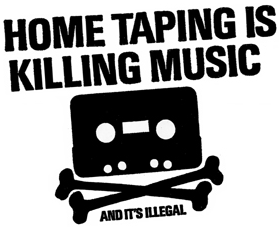
Home Taping Is Killing Music

Remember this slogan from the 1980s? The music industry was so bent out of shape about blank cassettes potentially destroying the sale of prerecorded music that there was even talk of imposing a preemptive royalty—to be paid to record labels—on the sale of blank tapes.


Overpaying Artists Is Killing Music


In 1997, the vice president of BMG China, Landow Lee, attributed the decline of the industry to artists getting too much money: "We all want artists to have their fair share, but overpaying them is destroying the music scene."


File Sharing Is Killing Music

Gene Simmons of KISS recently made this claim that file sharing is killing music. Simmons told Esquire magazine that file sharing has made a career in music "almost impossible":
It's very sad for new bands. My heart goes out to them. They just don't have a chance. If you play guitar, it's almost impossible. You're better off not even learning how to play guitar or write songs and just singing in the shower and auditioning for The X Factor.


Auto-Tune Is Killing Music

In 2010, Mother Jones ran an article titled "Is Auto-Tune Killing Pop Music?" The implication was yes, it is.


Lack of Education and Culture Is Killing Music

In 2003, the Scottish newspaper The Scotsman reported the death of classical music:
Welcome to the death of music, or that genre of it we define as classical. For more than a century it has captured the hearts and minds of millions, inspired the building of great concert halls in hundreds of cities, sustained thousands of musicians and created a discography that seemed timeless and enduring in its appeal. Well, timeless and enduring until now. For, despite private patronage and lashings of public funds, concert performance and ticket sales are in free fall.
The article went on to say:
Image from the Slate article "Classical Music in America Is Dead."
The thesis of the death of music is scarcely new, but seldom has the
speed and scale of the decline been more evident than now. And this
time it is being felt across every major orchestra right to the top.
Indeed, it is not at all lurid or fanciful to suggest that the
conventional classical music concert will die out within the next decade, unable to outlive the ageing demography of today's
concert-goers.
That was written just over a decade ago, and yet my local university still has a robust classical music concert schedule.


Steve Jobs and Digital Media Are Killing Music

"Steve Jobs is personally responsible for killing the music business," said Jon Bon Jovi in 2011. How did he do it? With—as The Register reported—his "singlehanded transformation of music from vinyl to digital."

Bon Jovi explained, "Kids today have missed the whole experience of putting the headphones on, turning it up to 10, holding the jacket, closing their eyes and getting lost in an album." He must not have heard about the vinyl resurgence. 


Fans Are Killing Music

Digital Music News said in 2013 that fans are killing music, but their argument was really that file sharing was killing music.